
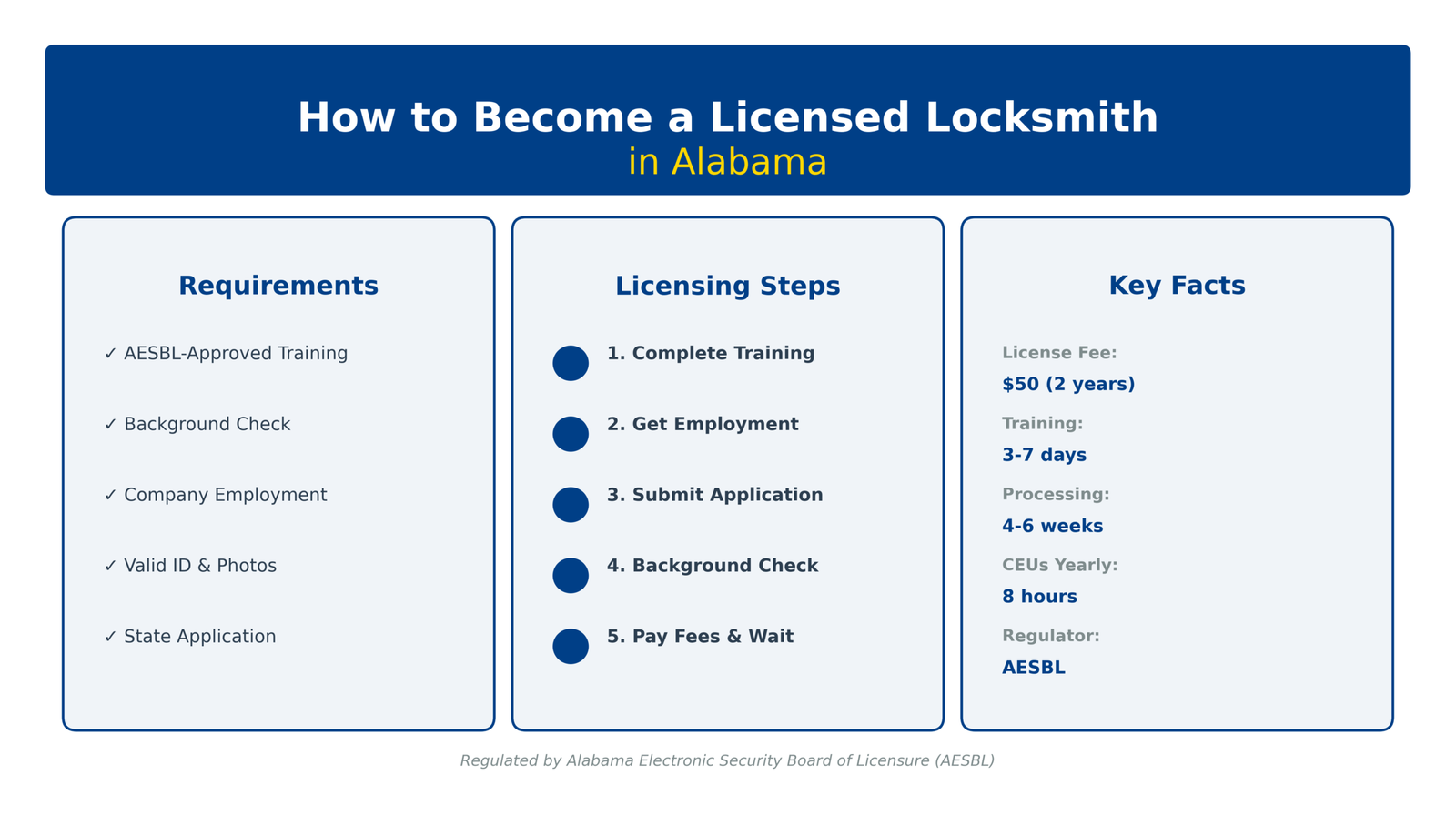
Yes, Alabama requires every locksmith to hold a state-issued license before performing any locksmith work. Licenses are issued by the Alabama Electronic Security Board of Licensure (AESBL). To qualify, you must complete AESBL-approved training, pass state and federal background checks, and be employed by (or own) a licensed locksmith business.
Here is the short version of the Alabama locksmith license process in 2026:
- Regulator: Alabama Electronic Security Board of Licensure (AESBL)
- Individual license fee: $50, valid for two years
- Background check: $38.25 through the Alabama Law Enforcement Agency
- Training: an AESBL-approved course (ALOA PRP, Alabama Locksmith Association, or ESA NTS)
- Total timeline: 2 to 3 months from start to finish
- Employment rule: you must work for or own a licensed locksmith business
This guide walks through every step of the Alabama locksmith license process: the difference between individual and business licenses, what training qualifies, how much everything costs, and what to do after you are approved. If you are still deciding on the career, start with what a locksmith does and how much locksmiths make.
Does Alabama Require a Locksmith License?
Yes. Alabama is one of the strictest states in the country for locksmith licensing. You cannot legally work as a locksmith without a license from the Alabama Electronic Security Board of Licensure (AESBL). The requirement applies to residential, commercial, and automotive locksmith services.
The state classifies locksmiths as “security professionals,” which means the license covers traditional mechanical lock work as well as modern electronic security systems.
Alabama sits with other strict licensing states like Florida, Georgia, and Texas. That is very different from neighboring states like Arkansas, which has no statewide locksmith license at all. If you are deciding where to base your business, see our full comparison of states that do and do not require a locksmith license.
What Counts as Locksmith Work in Alabama?
Alabama law defines locksmith work broadly. You are considered a locksmith if you perform any of the following for pay:
- Repair, rebuild, rekey, or adjust locks and mechanical locking devices.
- Install or service egress control devices.
- Work on vaults and safety deposit boxes.
- Create or copy transponder keys and automotive keys.
- Duplicate key fobs, proximity keys, or smart keys.
- Bypass locking mechanisms through picking, shimming, or other professional methods.
How to Get an Individual Alabama Locksmith License
The individual license path is for technicians working under a licensed locksmith company. Here are the five steps.
Step 1: Complete Approved Training
You must complete an AESBL-approved course before you apply. The main 2026 options are:
- ALOA Proficiency Registration Program (PRP): the national standard covering key identification and lock mechanisms.
- Alabama Locksmith Association (ALA) Beginner Class: a 5-day hands-on course ending with a 150-question exam.
- AESBL Certified Licensed Locksmith Alabama Exam.
Step 2: Find Employment with a Licensed Company
Alabama requires individual licensees to be affiliated with a licensed company. You generally cannot hold an active license unless you are employed by or own a registered locksmith business.
Step 3: Submit Your Application
Download the Individual Locksmith Application from the AESBL website. You will need:
- Two passport-sized photos.
- Training certificates.
- A signed and notarized Affidavit of Applicant.
- A copy of your current Alabama driver’s license.
Step 4: Complete the Background Check
Submit Alabama Law Enforcement Agency (ALEA) forms for state and federal background checks.
- Requirement: two fingerprint cards and a $38.25 fee paid to ALEA.
Step 5: Pay the License Fee
The individual license fee is $50, which covers a two-year period.
How to Get a Business Locksmith License in Alabama
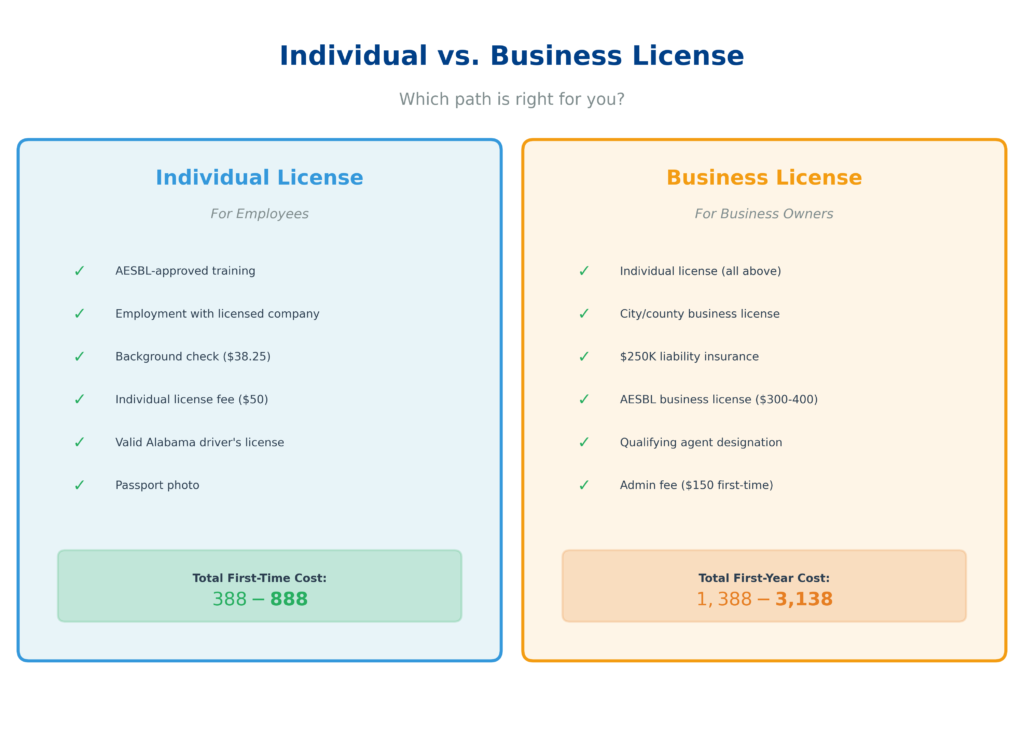
To start your own locksmith company in Alabama, you need both an individual license and a company license.
Prerequisites:
- A valid Alabama business license from your city or county.
- General liability insurance: minimum coverage of $250,000.
- Qualifying Agent (QA): you or a designated employee must serve as the technical lead.
Business application steps:
- Register the business: obtain your local business license and insurance. List the AESBL as a certificate holder on your insurance policy.
- Submit company paperwork: pay the $150 first-time admin fee plus the license fee ($300 for sole proprietors or $400 for LLCs and corporations).
- Designate a Qualifying Agent: the QA pays a fee of $50 to $150 depending on their technical disciplines.
- Wait for approval: AESBL review usually takes 4 to 6 weeks, then you receive your company license number.
Training Requirements for Alabama Locksmiths
Training must come from AESBL-approved programs. For 2026, the main providers are:
| Provider | Course Type | Contact/Focus |
| Alabama Locksmith Association | 5-day Beginner Class | Hands-on lock and safe work |
| ALOA (Associated Locksmiths of America) | PRP and ATC Exams | National certification standards |
| ESA (Electronic Security Association) | NTS Level 1 and 2 | Electronic access and CCTV |
Continuing Education (CEU)
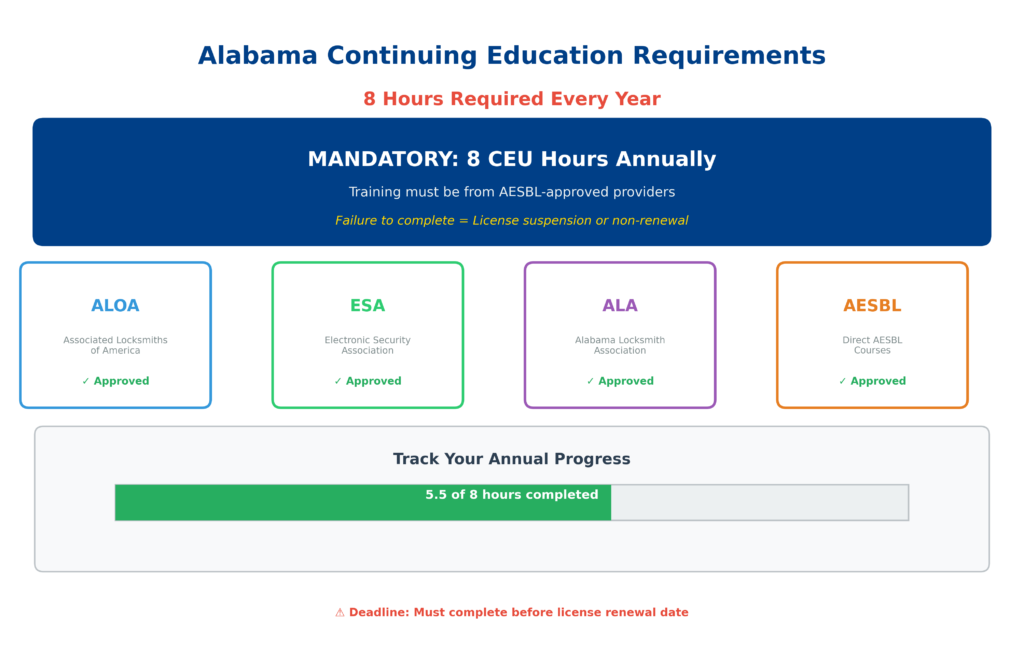
Alabama requires 8 hours of approved continuing education every year. You submit proof of 16 total hours at each biennial (every two years) renewal.
Cost and Timeline for 2026
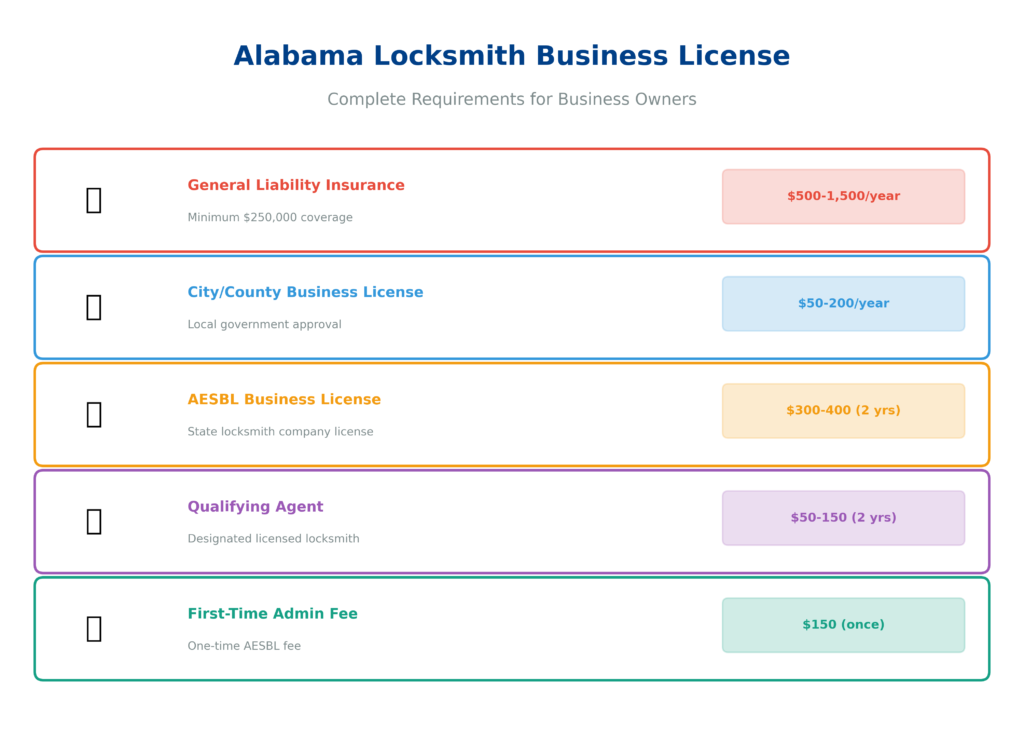
| Category | Item | Estimated Cost |
| Individual | Training | $400 to $975 |
| Background Check | $38.25 | |
| License Fee | $50 (2 years) | |
| Business | Admin Fee (one-time) | $150 |
| Company License | $300 to $400 (2 years) | |
| Insurance (annual) | $500 to $1,500 |
Timeline:
- Training: 5 to 7 days.
- Background check: 2 to 3 weeks.
- AESBL processing: 4 to 6 weeks.
- Total: expect 2 to 3 months from start to finish.
Other State Locksmith Licensing Guides
Locksmith licensing rules vary widely by state. If you are weighing your options or planning to work across state lines, these guides cover the full process in each:
States that require a locksmith license:
States with no statewide locksmith license:
Frequently Asked Questions
Can felons become locksmiths in Alabama?
Felons can become locksmiths depending on the offense. The AESBL reviews applications individually. Convictions older than seven years are usually not grounds for denial unless they directly relate to the profession, such as theft or fraud.
Does Alabama have license reciprocity with other states?
No. Alabama does not currently offer reciprocity. Even if you are licensed in Florida, Georgia, Texas, or another state, you must complete Alabama’s specific AESBL requirements.
Is Alabama Locksmith Association membership required?
No, Alabama Locksmith Association (ALA) membership is not required. However, the ALA Beginner Class is one of the AESBL-approved training routes, and the association is a common resource for continuing education hours and industry networking. You can apply for your Alabama locksmith license without joining.
Can I work as an automotive locksmith in Alabama?
Yes. The Alabama locksmith license covers automotive work, including cutting and programming car keys, replacing ignition cylinders, and duplicating transponder keys. Alabama does not issue a separate automotive locksmith license; the single AESBL license covers residential, commercial, and automotive work.
How much do locksmiths make in Alabama?
An average locksmith makes between $35,000 and $55,000 a year, with business owners in cities like Birmingham or Huntsville earning significantly more.
What practical skills should a new Alabama locksmith master?
Beyond the licensed work listed above, you should know how to verify ownership before opening a lock, how to open a locked house door without damage, and which lubricants to use on door locks during maintenance calls.
Resources
- AESBL: http://aesbl.alabama.gov/
- Applications: https://aesbl.alabama.gov/applicants/
- Training Programs: https://aesbl.alabama.gov/continuing-education/
- ALOA: https://www.aloa.org/
- ESA: https://www.esaweb.org/
