
Arkansas does not require a state locksmith license. You can start working as a locksmith after completing training, buying basic tools, registering your business, and getting liability insurance. No state exam, no fingerprinting, no waiting period.
Here is the short version of how to become a locksmith in Arkansas in 2026:
- State license: none required
- Training: ALOA online course, trade school, or paid apprenticeship ($500 to $2,000)
- Starter tools: $2,000 to $5,000 for a key machine, picks, and basic inventory
- Liability insurance: $400 to $1,000 a year for general liability
- Business setup: sole proprietor or LLC ($50 state filing), DBA ($25 county filing), plus local permits
- Average Arkansas salary: around $49,800 a year, with business owners earning $60,000 to $80,000
If you are still deciding on the career, start with what a locksmith does day to day, and how much locksmiths make across the country. This guide walks through the Arkansas-specific path: training, tools, business registration, skill-building, and getting your first customers in Little Rock, Fayetteville, Fort Smith, and smaller towns.
Does Arkansas Require a Locksmith License?
No. Arkansas is one of the friendliest states for aspiring locksmiths because it does not regulate the trade at all.
You do not need a state license, certification, or even formal training to work as a locksmith in Arkansas. You can finish an online course, buy some tools, and start taking customers the following week.
That said, you still need to know how to actually open doors and work with different lock types. Being legal and being good at your job are two different things. See our full comparison of states that do and do not require a locksmith license to understand how Arkansas compares.
How Much Do Locksmiths Make in Arkansas?
The average locksmith salary in Arkansas is around $49,799 a year, which breaks down to about $24 an hour. Not bad for a trade you can learn in a few months.
Entry-level locksmiths starting out typically make $35,000 to $40,000 annually. Once you have 2 to 4 years under your belt and can handle automotive work, you are looking at $48,000 to $56,000.
The real money comes from running your own business. Locksmith business owners in Arkansas regularly pull $60,000 to $80,000 once they are established. Emergency calls and automotive key programming bring in premium rates.
Arkansas has a lower cost of living compared to states like California or Connecticut, so your dollars stretch further here even if locksmith wages are slightly lower than coastal states.
Step 1: Get Locksmith Training
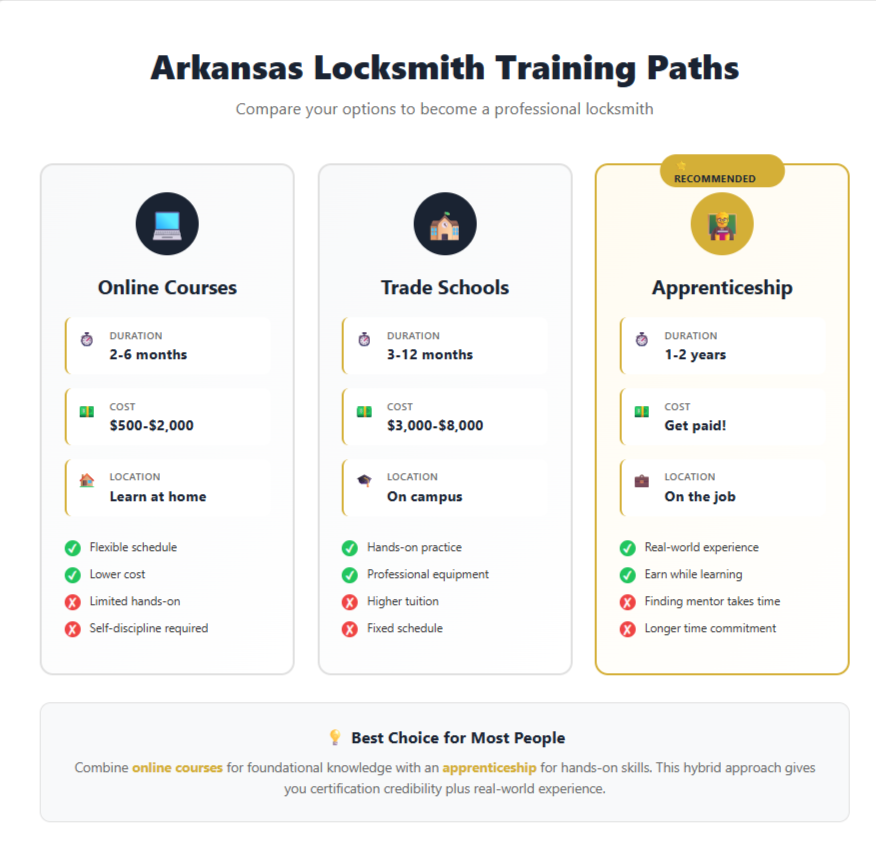
You need to actually learn the trade before you start cutting keys for people. There are three main paths in Arkansas.
Online Locksmith Courses
Online training is the most flexible option if you are working another job. Programs typically cost $500 to $2,000 and take 2 to 6 months to complete.
You will learn key cutting, lock installation, residential security systems, and basic automotive work. The downside is you are missing hands-on practice with actual locks and customers.
Penn Foster and ALOA (Associated Locksmiths of America) both offer solid online programs. ALOA courses give you credibility when you are starting out because they are recognized industry-wide. You will also learn how to identify different types of keys and lock mechanisms.
Trade Schools and Community Colleges
Arkansas does not have a lot of dedicated locksmith schools, but some community colleges offer security technology programs that cover locksmithing basics.
You might need to look at programs in neighboring states like Oklahoma or Missouri. The benefit is hands-on training with actual equipment and face-to-face instruction.
Expect to spend $3,000 to $8,000 on tuition if you go this route. The programs usually run 3 to 12 months depending on whether you are going full-time or part-time.
Apprenticeship Route
This is how most successful locksmiths actually learn. Find a working locksmith in Little Rock, Fort Smith, or wherever you are located and ask to work under them.
You will probably start unpaid or making minimum wage, but you are getting real experience. You will see how to handle difficult customers, verify ownership before opening locks, and deal with the business side.
Apprenticeships typically last 1 to 2 years. You are learning on the job while getting paid, which beats paying thousands for a course you will need to supplement anyway.
Step 2: Understand What Locksmiths Actually Do
Being a locksmith is not just cutting keys at a counter all day. You will handle a mix of residential, commercial, and automotive work.
Residential Services
Home lockouts are your bread and butter. Someone forgot their keys or broke off a key in the lock. You show up, get them inside, and make new keys without the original.
You will also install new locks when people move into a house, upgrade security systems, and rekey locks. Understanding different cupboard locks and mortise versus cylindrical locks matters more than you might think.
Commercial Work
Businesses need master key systems, safe installations, and access control systems. This work pays better but requires more technical knowledge.
You might install electronic locks, set up keycard systems, or work on high-security facilities. Commercial clients also provide steady, repeat business instead of one-off emergency calls.
Automotive Services
Car lockouts and key programming are big money makers. Modern vehicles need transponder keys that you program to the car’s computer system.
Learning how to program transponder keys and work with key fobs is essential. Some locksmiths specialize entirely in automotive work because the margins are better.
People also want to know if you can reprogram key fobs or copy existing fobs. Being able to say yes to these questions brings in more business.
Step 3: Get Your Tools and Equipment
You cannot work without the right tools. Budget at least $2,000 to $5,000 for a basic kit when starting out.
Essential Equipment
You will need a key cutting machine (manual or automatic), lock picks, tension wrenches, and key extractors. For automotive work, you need transponder key programmers and code cutting equipment.
A good key machine costs $500 to $2,000. Do not cheap out here. A machine that cuts bad keys destroys your reputation before you even get started.
Get quality lock lubricants too. Half the time a “broken” lock just needs proper cleaning and lubrication.
Mobile Setup vs. Storefront
You can run a mobile locksmith business from your truck or van. Lower overhead means more money in your pocket, especially when starting out.
A storefront in Little Rock or Fayetteville costs $1,000 to $3,000 a month in rent, plus utilities and insurance. Mobile setups just need a reliable vehicle and organized tool storage.
Many successful Arkansas locksmiths run hybrid operations. They have a small shop for key cutting and complex work but do most service calls from their vehicle.
Step 4: Register Your Business in Arkansas
Even though Arkansas does not require a locksmith license, you still need to set up your business properly.
Choose Your Business Structure
Most locksmiths start as sole proprietors because it is simple. You are personally liable for everything, but you can use your own Social Security number for taxes.
An LLC protects your personal assets if something goes wrong. If someone sues your locksmith business, they cannot come after your house or savings. LLC formation in Arkansas costs around $50 for state filing.
Register Your DBA (Doing Business As)
If you want to operate as “Arkansas Lock and Key” instead of “John Smith,” you need to file a DBA with your county clerk.
The process varies slightly by county, but it is generally straightforward. You will pay a $25 filing fee at the county clerk’s office where you operate your business. The registration lasts five years before you need to renew.
For LLCs and corporations, you also need to file with the Arkansas Secretary of State and then submit a copy to your county clerk. Pulaski County is the exception. They only require state-level registration.
Get Business Insurance
General liability insurance protects you if you damage someone’s property while working. Costs run $400 to $1,000 a year for basic coverage.
Many commercial clients will not hire you without proof of insurance. It is also required if you want to apply for certain business licenses or city permits.
Bonding is different from insurance but equally important. Some customers, especially commercial ones, want to see that you are bonded. It proves you are trustworthy and protects them if you steal something.
Apply for Local Permits
Check with your city or county about business licenses. Requirements vary across Arkansas, so what applies in Little Rock might not apply in Conway.
Some cities require contractor licenses for locksmith work. Others just want you to register as a business and pay a small annual fee. Call your city hall and ask specifically about locksmith requirements.
Step 5: Build Your Skills and Certifications
No license does not mean no learning. The best locksmiths never stop improving their skills.
ALOA Certifications
The Associated Locksmiths of America offers professional certifications that boost your credibility. Registered Locksmith (RL) is the entry-level cert, followed by Certified Registered Locksmith (CRL).
Specialized certifications exist for automotive work, safe and vault technician, and institutional locksmithing. These cost $100 to $500 each but they show customers you are serious about your craft.
ALOA membership also gives you access to training seminars, industry updates, and a network of other locksmiths who can answer questions.
Manufacturer Training
Lock manufacturers like Schlage, Kwikset, and Medeco offer training on their specific products. Some training is free, some costs a few hundred dollars.
This training matters because customers ask about specific brands. Being able to say “I am certified on Schlage commercial systems” wins jobs.
Continuing Education
Lock technology changes constantly. Electronic locks, smart home systems, and biometric access all evolve quickly. You need to stay current or you will lose business to locksmiths who do.
Attend ALOA conventions, take online courses, and join locksmith forums where pros share new techniques. The trade evolves fast.
Step 6: Start Getting Customers
Having skills and tools means nothing if nobody calls you. Marketing matters just as much as technical ability.
Get Found Online
Set up a Google Business Profile immediately. When someone in Little Rock searches “locksmith near me” at 3 AM, you want to show up.
Add photos of your work, respond to reviews (good and bad), and keep your hours updated. Most locksmith calls come from Google, especially emergency situations.
A simple website helps too. Nothing fancy. Just your services, prices, service area, and phone number. Make sure it works on mobile since most people will find you on their phones.
Build Local Relationships
Real estate agents, property managers, and car dealerships all need locksmiths regularly. Introduce yourself, drop off business cards, and offer a discount for their first call.
One property manager with 50 rental units can keep you busy for years. Focus on relationships that bring repeat business, not just one-time emergency calls.
Set Your Prices Right
Standard lockouts in Arkansas run $75 to $150 depending on the situation. Emergency after-hours calls cost more, at $100 to $200.
Rekeying costs $15 to $25 per lock. Key cutting is $2 to $10 depending on the key type. Automotive transponder key programming runs $100 to $300.
Do not underprice yourself trying to compete with every other locksmith. You will burn out fast at $50 per call. Price yourself fairly and deliver excellent service.
Step 7: Handle the Business Side
Being a good locksmith and running a good locksmith business are different skills. Most techs fail because they ignore the business fundamentals.
Track Your Money
Open a separate business bank account. Do not mix business and personal money. It makes taxes a nightmare and looks unprofessional.
Use simple accounting software or even a spreadsheet to track income and expenses. You need to know if you are actually making money or just staying busy.
Get an EIN
If you plan to hire employees or want to establish business credit, get an Employer Identification Number (EIN) from the IRS. It is free and takes 10 minutes online.
Sole proprietors can use their Social Security number, but an EIN keeps your personal info private when dealing with customers and vendors.
Pay Your Taxes
Arkansas charges sales tax on locksmith services in most cases. Check with the Arkansas Department of Finance and Administration about your specific situation.
As a self-employed locksmith, you will pay self-employment tax (15.3 percent) plus income tax. Set aside 25 to 30 percent of every payment for taxes so you are not scrambling in April.
Common Challenges for New Locksmiths in Arkansas
What actually trips people up when they are starting out:
Slow Starts Are Normal
Your phone will not ring constantly in month one. Building a reputation takes 6 to 12 months of consistent work and good service.
Keep another income source at first if possible. You need breathing room to build your business without panicking about every missed call.
Emergency Call Stress
Late-night lockouts and frantic customers test your patience. Someone who is locked out at 2 AM is not thinking clearly and might be rude.
Learn to stay calm and professional. How you handle stressed customers determines whether they leave 5-star reviews or blast you online.
Scam Artist Reputation
Locksmith scams are unfortunately common. Some “locksmiths” quote $50 on the phone, then charge $400 when they arrive.
Be transparent about pricing from the start. If you say $100 on the phone, charge $100. Building trust in a scammy industry is actually your competitive advantage.
Specialized Locksmith Services to Consider
Once you are established, specializing in specific areas can significantly increase your income.
Safe and Vault Work
Safes require specialized knowledge and tools. Not many locksmiths do this work, so competition is lower and prices are higher.
If you are willing to learn safe manipulation and repair, businesses and homeowners will pay premium rates. Check out our guide on safe services for more details.
Automotive Specialization
Car dealerships and auto body shops need locksmiths who can program keys quickly. Some locksmiths make $80,000 and up focusing entirely on automotive work.
You will need to invest in programming equipment and stay updated on new car security systems. But the repeat business from dealerships provides steady income.
Understanding ignition cylinder replacement also opens up more automotive opportunities.
Access Control Systems
Commercial clients need keycard systems, electronic locks, and integrated security. This work requires electronics knowledge but pays well.
A single installation might take a week and bring in $5,000 to $20,000. Plus, businesses need ongoing maintenance and support.
Tips for Success in Arkansas
What separates locksmiths who make $40,000 from those making $80,000:
Be Available and Responsive
Answer your phone. Half your competition will not pick up after 5 PM, so being available gives you a massive advantage.
Even if you cannot take the job immediately, answer and give them a time frame. People calling locksmiths are usually stressed, so just talking to someone helps.
Show Up When You Say You Will
If you tell someone you will be there in 30 minutes, be there in 25. Reliability is rare in this industry, so being dependable makes you stand out.
One Arkansas property manager has used the same locksmith for 10 years simply because he always shows up on time. That is the whole reason.
Document Everything
Take photos before and after every job. Get signatures confirming you completed the work. This protects you if someone later claims you damaged something.
Ask customers how they heard about you and track this information. You need to know which marketing actually brings in business.
Collect Reviews Aggressively
After every good job, ask for a Google review. Text the customer a direct link to make it easy.
Twenty 5-star reviews will bring you more business than any paid advertising. Social proof matters more than anything in service industries.
Should You Join a Trade Association?
ALOA membership costs around $225 a year. For new locksmiths, it is worth it for the training resources and credibility.
Local locksmith associations exist in larger Arkansas cities. These groups share information about problem customers, industry changes, and business opportunities.
The networking alone pays for membership. When you are stuck on a weird lock you have never seen, having other locksmiths to call is invaluable.
Legal and Safety Issues
You are accessing people’s homes and businesses. Take security seriously.
Background Checks
Even though Arkansas does not require background checks for locksmiths, getting one voluntarily builds trust. Many commercial clients will ask for it anyway.
A clean background check costs $20 to $50 and proves you are not running a criminal operation disguised as a locksmith business.
Verifying Ownership
Always verify that the person asking you to open a lock actually has the right to enter. Check ID and ask for proof of residence or ownership.
Our full guide on verifying ownership covers specific steps to protect yourself legally. Do not skip this. You can face serious consequences for helping someone break into a property they do not own.
Stay Current on Laws
While Arkansas does not require locksmith licensing now, that could change. Stay informed about potential legislation affecting your trade.
Some cities might add local requirements even if the state does not. Check our licensing guide to understand how different states regulate locksmiths.
Arkansas-Specific Business Tips
Each state has unique characteristics that affect your locksmith business.
Weather Considerations
Arkansas gets hot, humid summers and occasional ice storms in winter. Keep extra tools and supplies in your vehicle because weather can prevent you from returning to your shop.
Lock mechanisms behave differently in extreme temperatures. Locks that worked fine in May might stick in January when it is 20 degrees out.
Urban vs. Rural Opportunities
Little Rock, Fort Smith, and Fayetteville have steady customer bases year-round. Rural areas have less competition but also fewer potential customers.
Consider your service radius carefully. Driving 45 minutes for a $75 lockout is not profitable. Set minimum trip charges for distant calls.
State Resources
The Arkansas Small Business Administration office in Little Rock offers free business counseling and resources for new entrepreneurs.
Contact them at (501) 324-7379 or visit their office at 2120 Riverfront Drive. They can help with business plans, loan applications, and understanding local requirements.
Other State Locksmith Licensing Guides
Locksmith licensing rules vary widely by state. If you are weighing your options or planning to work across state lines, these guides cover the full process in each:
States that require a locksmith license:
Other states with no statewide locksmith license:
Frequently Asked Questions
Can a felon become a locksmith in Arkansas?
Yes. Arkansas does not prohibit felons from working as locksmiths since there is no state licensing requirement. However, your background might affect whether businesses hire you or if you can get bonded.
Do customers tip locksmiths in Arkansas?
Tipping is not expected but happens occasionally, especially for after-hours emergency calls. If you are curious about industry norms, check our guide on whether to tip locksmiths.
Does insurance cover locksmith services in Arkansas?
Homeowners insurance sometimes covers locksmith costs for break-ins or damaged locks, but rarely for lockouts. Read our detailed breakdown on insurance coverage for locksmith services.
How long does it take to become a locksmith in Arkansas?
You can technically start working in 1 to 2 weeks if you are willing to take an intensive online course and buy tools. Realistically, plan for 3 to 6 months to get proper training and build basic competence.
What is the difference between licensed and unlicensed locksmiths?
In Arkansas, there is no distinction because the state does not require licensing. However, locksmiths with ALOA certifications or training from recognized programs are generally more skilled than someone who just bought lock picks online.
Can I work as a locksmith across state lines?
If you work near the Arkansas border and want to take jobs in Tennessee, Oklahoma, or other neighboring states, check their licensing requirements. States like Texas and North Carolina have strict locksmith regulations you will need to follow.
Final Thoughts
Becoming a locksmith in Arkansas is straightforward compared to states with heavy regulations. No mandatory licensing, lower costs, and steady demand make it an attractive trade.
The key is getting proper training even though it is not required. Customers do not care about state regulations. They care about whether you can get them into their house without destroying their door.
Start small, build your skills, and focus on reputation. In a year, you could be making more than you did at your desk job and actually enjoy Monday mornings.
