
If your car locked with the key fob inside, it is almost always because the car lost track of the fob’s signal and assumed you left with it. The four common causes are a weak fob battery, a “dead zone” inside the cabin, signal interference from metal objects or phones, and a faulty door sensor triggering auto-relock.
Here is the quick diagnosis to run before anything else:
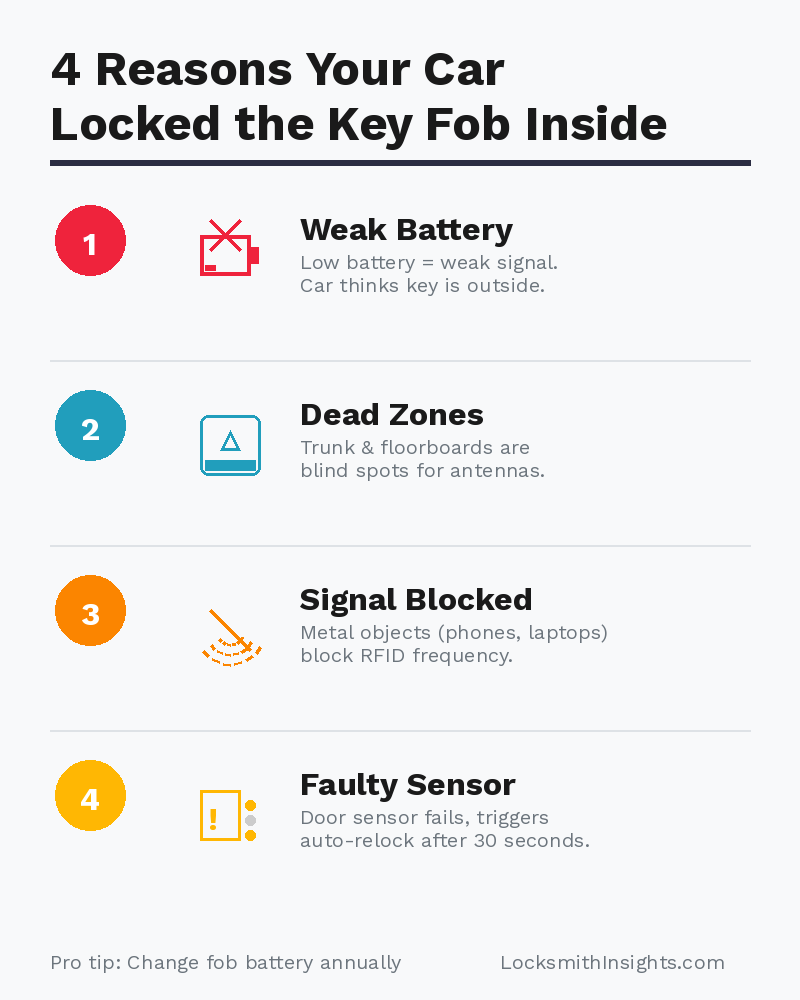
- Weak fob battery: signal too faint for the car’s sensors to detect the key inside.
- Dead zones: fob sitting in a blind spot (trunk, deep floorboard) where the interior antennas cannot reach.
- Signal interference: smartphones, laptops, or metal water bottles blocking the fob’s RFID signal.
- Faulty door sensor: car did not register the door opening, so the 30-second auto-relock engaged with the fob still inside.
The rest of this post explains each cause in plain English and walks you through what to do right now if you are locked out.
Smart keys are supposed to make this impossible. Yet here you are, staring through the window at your key fob sitting on the driver’s seat.
This is not just bad luck. It is a specific software or hardware failure. Modern cars have safety overrides to prevent this, but they are not perfect. Below are the technical reasons why your “smart” key failed, and how to get back inside.
1. The “Dead Zone” Theory (Most Common)
Your car’s internal antennas do not cover every square inch of the cabin. There are specific “blind spots” where the sensor signal simply does not reach.
The trunk is the worst offender. If your key fob is buried in a gym bag in the trunk, the car often cannot see it. The same applies to the floorboard behind the front seats. If the car loses track of the key, it assumes you took it with you. You close the door, and it locks automatically to secure the vehicle.
2. The Dying Battery Effect
A low battery does not mean your fob stops working entirely. It just weakens the signal.
The car constantly “pings” the key for an authorization code. If the battery is weak, that response is faint. The car interprets this weak signal as the key being outside the vehicle. When you close the door, the security system engages because it did not receive a strong confirmation that the key was still inside.
Pro Tip: change your fob battery once a year. It is a $5 fix that prevents a $150 lockout. If your fob has started failing completely, you may be looking at a replacement. See our guide on whether key fobs can be copied and reprogramming fobs for details on what a locksmith can and cannot do.
3. Interference and the “Faraday” Accident
Metal objects block RFID signals. It is basic physics, but it causes lockouts daily. Common signal blockers include:
- Metal water bottles (like Yetis or Hydroflasks)
- Laptops (especially aluminum MacBooks)
- Smartphones sitting directly on top of the fob
If your fob is sitting under a laptop, the car pings the key and gets no response. It assumes the car is empty and locks it. You did not remove the key. The car just could not find it through the metal.
4. The “30-Second” Auto-Relock Glitch
Most modern cars (Toyota, Honda, Ford) have a safety feature: if you unlock the car but do not open a door within 30 seconds, it re-locks automatically.
The Glitch: sometimes a faulty door latch sensor fails to register that you opened the door. You toss your keys inside, close the door, and the computer thinks the door was never opened in the first place. It then triggers the auto-relock with your keys trapped inside.
What to Do If You Are Locked Out
- Check the Trunk: sometimes the trunk remains unlocked even if the cabin locks.
- Use the App: check your Toyota App, FordPass, or MyChevrolet app. You can often unlock the car via your phone even if you have not used the app in months.
- Do NOT Use a Coat Hanger: modern cars have side-impact airbags in the door pillars. Jimmying the door yourself can trigger an airbag or strip the complex wiring inside the door, causing over $1,000 in damage. Professional locksmiths use specialized tools that will not trigger your airbags or scratch your paint.
If you are completely stuck, call a licensed automotive locksmith. Locksmiths verify ownership through your ID and vehicle registration before providing entry, which protects your vehicle from theft. Most insurance policies cover locksmith services for emergency lockouts, making professional help more affordable than you might think.
What Happens After the Lockout
Once you are back in the car, it is worth figuring out whether you have a one-time incident or an ongoing fob problem. A few follow-up steps to consider:
- Replace the fob battery (CR2032 or CR2025, usually under $5 at any drug store). This fixes the majority of intermittent issues.
- Get a backup key made. A locksmith can often make you a spare for less than the dealer. See whether locksmiths can make car keys and making a key without the original for what is possible with your model.
- If the issue keeps happening, you may need transponder key reprogramming or, in rare cases, ignition cylinder replacement. A dealer or automotive locksmith can diagnose which one you need.
Frequently Asked Questions (FAQ)
Can a car lock itself with the keys in the ignition?
Yes. If the door sensor is faulty, the car may not realize the door was opened and can re-engage the locks automatically, even if the key is in the ignition (for older models) or in the cup holder (for push-to-start cars).
Does a dead key fob battery cause lockouts?
Yes. A weak battery reduces the signal strength. The car may fail to detect the key is inside the cabin and lock the doors as a security measure.
How do I unlock my car if my keys are inside?
First, check if your manufacturer has a mobile app (like FordPass or OnStar) to unlock it remotely. If that fails, contact a professional locksmith to use an air wedge or Lishi tool to open the door without damaging the airbags or weather stripping.
Locked out right now? Contact a professional automotive locksmith for fast, damage-free entry. And if you are wondering whether to tip your locksmith, most appreciate it, but solid online reviews help just as much.
