
Alaska does not require a state locksmith license. You can start working as a locksmith after getting a $50 state business license, liability insurance, and basic training through ALOA or a similar accredited program. No state exam, no fingerprinting, no waiting months for background check approvals.
Here is the short version of how to become a locksmith in Alaska in 2026:
- State license: none required
- Business license: $50 for five years through Alaska’s Department of Commerce
- Training: ALOA Basic Locksmithing Course or Penn Foster Career School ($699 to $899)
- Liability insurance: $500 to $1,200 a year (required by most clients and insurers)
- Total timeline: 2 to 3 months from enrolment to first paid job
- Average Alaska salary: $56,000 to $60,000, with experienced locksmiths earning $80,000 and up
If you are still deciding on the career, start with what a locksmith does day to day, and how much locksmiths make across the country. This guide walks through the Alaska-specific path: training, business setup, insurance, and the specializations that pay best in Anchorage, Fairbanks, and Juneau.
Why Alaska Is Different (No State Locksmith License Required)
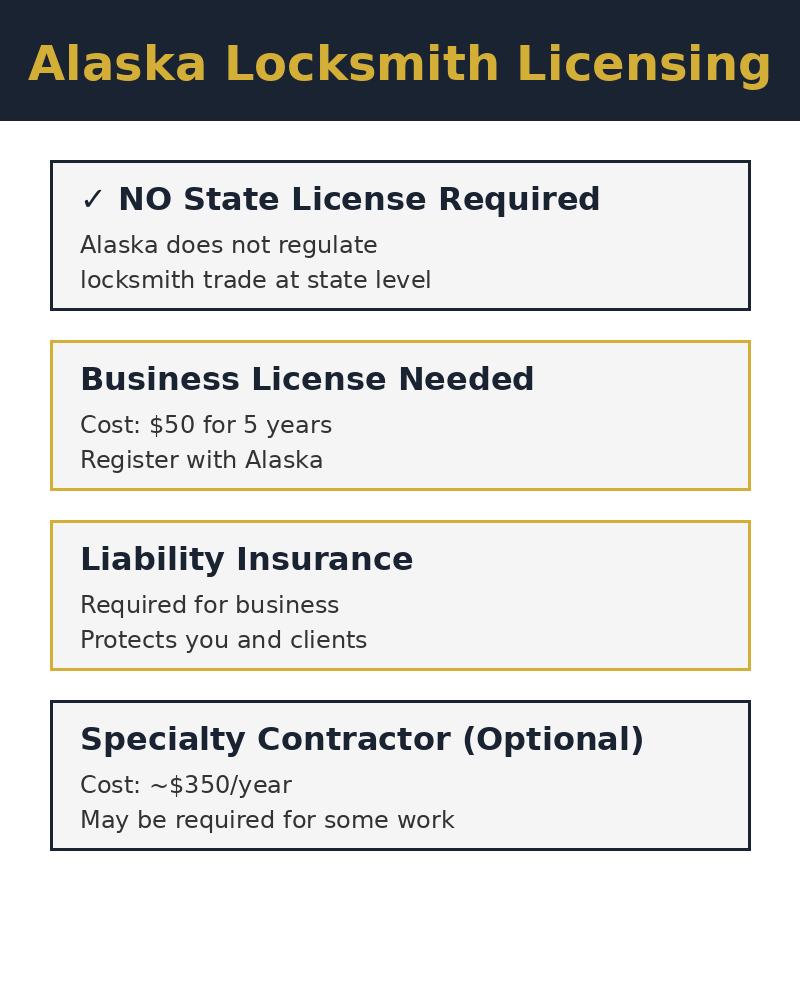
Alaska is one of 37 states that does not regulate the locksmith trade at the state level. Roughly 13 states do require a locksmith license, including Alabama, California, Connecticut, Illinois, Louisiana, Maryland, Nevada, New Jersey, North Carolina, Oklahoma, Oregon, Texas, and Virginia.
What does “no license required” actually mean for you? You can start working as a locksmith after completing basic training. You do not need to pass a state exam, submit fingerprints to multiple agencies, or wait months for background check approvals. You can finish a training course and start working the next week.
There is a catch. Alaska not requiring a state license does not mean you are operating in a regulatory vacuum. See our full state-by-state locksmith licensing comparison for context on where your state fits.
What You Actually Need to Work as a Locksmith in Alaska
Even though Alaska does not require a locksmith-specific license, you still need to handle some business basics.
Business License ($50 for 5 Years)
Every locksmith operating in Alaska needs a general business license. Whether you are working for someone else or starting your own shop, this is non-negotiable.
The cost is $50 for a five-year license through Alaska’s Department of Commerce, Community, and Economic Development. That comes out to $10 a year, which is nothing compared to states that charge $200 or more annually.
You register your business through the state’s licensing portal. The process takes about 30 minutes if you have your business structure sorted out (sole proprietor, LLC, and so on).
Specialty Contractor License ($350/Year, Optional)
This is where it gets slightly murky. Some locksmiths in Alaska register as specialty contractors, which requires a contractor’s license costing around $350 a year.
Do you need it? It depends on the type of work you do. If you are primarily working on residential and commercial security systems, access control, or doing major installation work, the specialty contractor license covers your bases. If you are mostly doing lockouts and key duplication, you probably do not need it.
Call Alaska’s Division of Corporations, Business and Professional Licensing at (907) 465-2550 and describe exactly what services you plan to offer. They will tell you if the specialty contractor license applies to your situation.
Liability Insurance (Required)
Liability insurance is not optional. You need it to protect yourself and your clients.
Most insurance carriers require minimum coverage of:
- $50,000 for injury or death to one person
- $100,000 for injury or death to multiple people
- $20,000 for property damage
Expect to pay $500 to $1,200 annually for basic liability coverage. Rates vary based on your revenue, number of employees, and whether you offer automotive services, which are higher risk due to expensive vehicle electronics.
Without insurance, one mistake can bankrupt you. An uninsured locksmith who damages a $5,000 smart lock system has nowhere to turn. With insurance, the claim gets paid.
How to Become a Locksmith in Alaska: Step-by-Step Training Path
Training is where most aspiring locksmiths either succeed or flame out. You do not need a four-year degree. You also cannot learn this from YouTube videos alone.
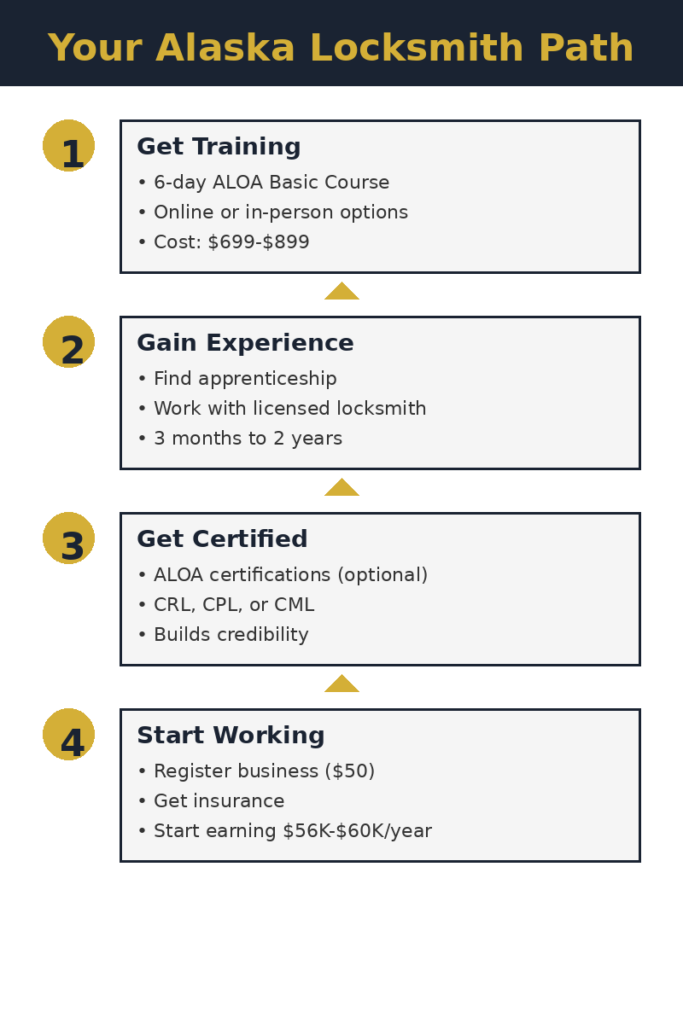
Step 1: Complete ALOA’s 6-Day Basic Locksmithing Course
The Associated Locksmiths of America (ALOA) offers the gold standard training for new locksmiths. Their 6-day Basic Locksmithing Course covers what you need to know to start working safely and legally.
What you will learn:
- Key identification, duplication, and impression techniques
- Pin tumbler lock operation and installation
- Basic master keying systems
- Non-destructive lock opening techniques
- Code cutting and key machine operation
- Door hardware installation and repair
- Customer service and ethics
The course costs between $699 and $899 depending on whether you take it online or in-person. Online courses let you work at your own pace. In-person training at ALOA’s Dallas training center or annual convention gives you hands-on practice with actual locks and tools.
After completing the course, you receive your ALOA Fundamental Locksmith (AFL) certificate. This is not a license, but it proves to employers and customers that you completed legitimate training.
Step 2: Find an Apprenticeship in Alaska
Classroom training is good. Real-world experience is essential.
Most locksmiths learn the trade by working under an experienced technician for 3 months to 2 years. You will respond to emergency lockouts, install commercial access control systems, and handle situations your training course never covered, like the customer who “just needs one key” but has a 15-lock master key system.
Finding an apprenticeship in Alaska can be challenging because the state has a smaller population. Here is where to start:
Contact local locksmith shops in Anchorage, Fairbanks, or Juneau. Call them directly. Do not just email a resume. Explain that you are trained and looking for hands-on experience. Some shops will hire you immediately if you have your AFL certification.
Many apprenticeships are paid, though expect entry-level wages of $15 to $20 an hour while you are learning. Some locksmiths offer unpaid internships, but your time has value and legitimate professionals know that.
Step 3: Get ALOA Certifications (Optional But Recommended)
Once you have some experience, consider getting certified through ALOA’s Proficiency Registration Program (PRP). These certifications are not required in Alaska, but they make you more marketable and let you charge higher rates.
The main certification levels:
Certified Registered Locksmith (CRL): entry-level certification requiring you to pass a mandatory exam plus two elective exams in specialized areas like automotive locks, safe servicing, or access control.
Certified Professional Locksmith (CPL): mid-level certification demonstrating advanced skills. Requires passing the mandatory exam plus five electives.
Certified Master Locksmith (CML): top-tier certification. Requires passing the mandatory exam plus nine electives. Less than 1 percent of locksmiths hold this certification.
Each certification level takes 6 to 18 months to complete depending on how much time you dedicate to studying and taking exams.
Do you need these certifications? No. Will they help you win commercial contracts and charge $150 an hour instead of $75? Yes.
Step 4: Register Your Business and Start Working
Once you complete training and gain some experience, you are ready to start working independently. Here is your checklist:
Register your business with Alaska ($50 for 5 years). Choose your business structure. Most new locksmiths start as sole proprietors for simplicity, though forming an LLC gives you personal liability protection.
Get liability insurance ($500 to $1,200 a year). Shop around with carriers that specialize in locksmith insurance. Do not just grab the cheapest policy. Make sure it covers automotive work if you are offering car lockout services.
Buy your tools and equipment ($2,000 to $5,000 initial investment). At minimum, you will need a key machine, plug spinners, pick sets, impressioning tools, and a van or truck if you are offering mobile service.
Set up a business phone number and basic website. Customers in Alaska search for emergency locksmith services online. If you are not showing up on Google Maps, you are leaving money on the table.
Alaska Locksmith Salary: What You Will Actually Make
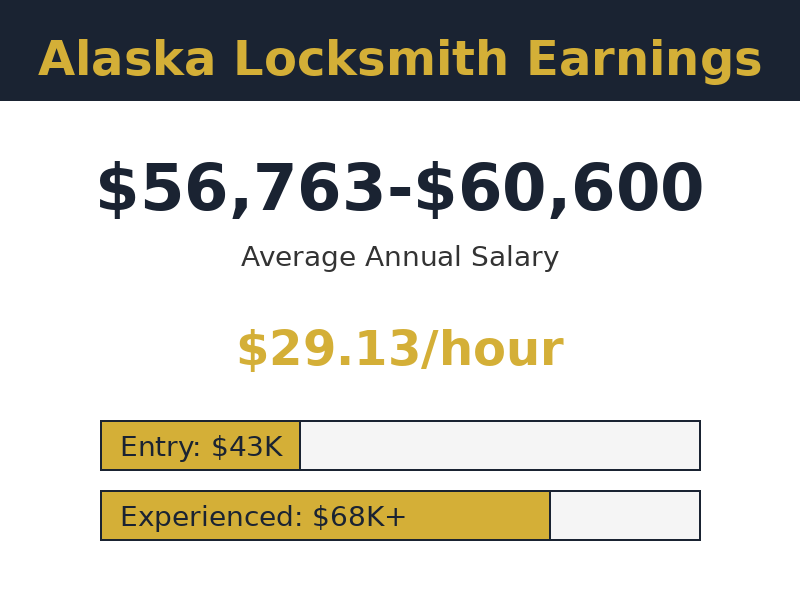
The average locksmith salary in Alaska ranges from $56,763 to $60,600 a year, according to industry surveys. That breaks down to approximately $29.13 an hour.
Averages do not tell the whole story. Here is what actually determines your income:
Location Matters
Anchorage locksmiths earn more than those in smaller towns simply because there is more demand. A locksmith in Anchorage might charge $125 for a residential lockout, while someone in a rural area might charge $75.
Rural locksmiths often have less competition. If you are the only locksmith within 50 miles, you control pricing.
Service Type Matters More
Residential lockouts are your bread and butter, but they are not where you make real money. Commercial work pays significantly better.
Installing a commercial access control system might net you $3,000 to $10,000 on a single job. Rekeying an apartment complex with 200 units could be a $5,000 contract. Automotive programming for high-security car keys runs $150 to $400 per key.
The locksmiths making $80,000 and up in Alaska focus on commercial and automotive services, not residential lockouts.
Business Model Matters Most
Working for an established locksmith company? Expect $40,000 to $50,000 annually with benefits.
Running your own mobile locksmith business? You can hit $60,000 to $80,000 once you are established, but you cover all your own expenses (vehicle, insurance, tools, marketing).
Building a storefront locksmith shop with employees? Done properly, $100,000 and up is realistic. But you are not just a locksmith at that point. You are a business owner.
Entry-Level vs. Experienced Earnings
First-year locksmiths typically earn $35,000 to $43,000 while they are building skills and a customer base. After 2 to 3 years, expect $50,000 to $65,000. With 5 or more years of experience and professional certifications, $70,000 and up is achievable.
Specialized locksmiths, like those focusing on safes or automotive high-security systems, earn $90,000 and up annually because they have developed rare skills that few competitors can match.
Best Locksmith Training Schools for Alaska Residents
You do not need to fly to Dallas for training. Here are your best options as an Alaska resident:
ALOA Online Training
The most convenient option for Alaska locksmiths is ALOA’s online training programs. You can complete the 6-day Basic Locksmithing Course entirely online at your own pace.
Cost: $699 to $899. You get video lessons, downloadable manuals, access to instructors, and your AFL certificate upon completion.
ALOA Convention and Security Expo
ALOA hosts an annual convention with hands-on training classes. If you can swing the travel costs, this is one of the best ways to network with other locksmiths and learn from industry experts.
You get access to 200 or more training classes, a trade show with tool manufacturers, and certification testing opportunities.
Penn Foster Career School
Penn Foster offers an accredited online locksmith diploma program that you can complete in as little as 2 months. The program costs around $899 and covers residential, commercial, and automotive locksmithing.
While not as hands-on as ALOA training, it is affordable and self-paced, which works well for Alaska residents who cannot travel for in-person training.
Local Apprenticeships
The best “school” is working alongside an experienced locksmith. If you can find a local shop in Anchorage or Fairbanks willing to train you while paying you, that is better than any classroom course.
You will learn how to handle difficult customers, price your services, and deal with situations that never come up in training, like opening a frozen lock at minus 20 degrees Fahrenheit in the middle of winter.
Specializations That Pay More in Alaska
Once you master basic locksmithing, these specializations command higher rates:
Automotive Locksmithing
Modern vehicles use transponder keys, proximity fobs, and encrypted security systems. Programming a new key for a 2024 truck can cost the customer $200 to $400. See our guides to making car keys and duplicating key fobs for the technical side.
Alaska has a lot of trucks and SUVs because of the winter conditions. If you can program keys for Ford F-150s, Chevy Silverados, and Toyota Tundras, you will stay busy. You should also know how to replace ignition cylinders on older vehicles.
ALOA offers specialized automotive training through the International Association of Automotive Locksmiths (IAAL). Expect to invest $1,500 to $3,000 in training and tools for this specialization.
Safe and Vault Services
Opening, repairing, and installing safes is skilled work that pays well. A simple safe opening might be $200 to $500. Installing a commercial vault could be a $10,000 and up job.
Alaska’s businesses need secure storage for cash, documents, and valuables. If you can work on Diebold, SentrySafe, and Liberty Safe products, you will differentiate yourself from competitors.
Commercial Access Control
Electronic access control systems are the future of commercial security. These systems let businesses control who enters buildings using key cards, biometric readers, or smartphone apps.
Installation and maintenance contracts for these systems generate recurring revenue. A single commercial client might pay you $500 to $2,000 annually just for system monitoring and maintenance.
This specialization requires understanding networking, electronic security, and software configuration. It is not just about turning keys anymore.
Other State Locksmith Licensing Guides
Locksmith licensing rules vary widely by state. If you are weighing your options or planning to work across state lines, these guides cover the full process in each:
States that require a locksmith license:
Other states with no statewide locksmith license:
Common Questions About Becoming a Locksmith in Alaska
Can a Felon Become a Locksmith in Alaska?
Yes. Alaska does not have automatic disqualifications for people with criminal records because there is no state licensing requirement. Our detailed guide on whether felons can become locksmiths covers the full picture.
Individual locksmith companies may run background checks before hiring. If you need a specialty contractor license, the state will review your criminal history. Violent crimes and theft convictions will likely be problematic.
If you have a criminal record, be upfront about it when applying for jobs or getting bonded through ALOA’s bonding program.
How Long Does It Take to Become a Locksmith in Alaska?
Fast track: 2 to 3 months. Complete online training (6 days to 2 months depending on the program), then start working immediately.
Traditional path: 6 to 18 months. Complete training, work as an apprentice for 6 to 12 months, then start your own business or move into a senior role.
Professional path: 2 to 4 years. Complete training, gain experience, earn ALOA certifications (CRL, CPL, or CML), develop specializations, and build a reputation as a top-tier locksmith.
Do I Need to Take a Test to Become a Locksmith in Alaska?
No state test is required. Alaska does not administer locksmith exams.
If you pursue ALOA certifications, you will need to pass their proficiency exams. These are not easy. They test your practical skills, not just theoretical knowledge.
Can I Start a Mobile Locksmith Business in Alaska?
Yes. Many Alaska locksmiths operate as mobile-only businesses because overhead costs are lower than maintaining a storefront.
You need a reliable van or truck, tools, a business license, insurance, and a way for customers to find you (Google Business Profile, website, and so on). Initial investment: $10,000 to $20,000 for a used van and equipment.
Mobile locksmiths in Alaska do well because customers need emergency service wherever they are. If someone is locked out of their cabin 30 miles outside Fairbanks, they will pay premium rates for someone willing to drive out there.
What Is the Busiest Season for Locksmiths in Alaska?
Winter. Locks freeze, people lock keys in running cars to keep them warm, and heating system access issues create security problems.
Summer is not slow either. Tourism picks up, people move houses, and businesses upgrade security systems. A good Alaska locksmith stays busy year round.
Next Steps: Your Alaska Locksmith Checklist
If you are serious about becoming a locksmith in Alaska, here is what to do this week:
- Enrol in ALOA’s online Basic Locksmithing Course or another accredited program ($699 to $899).
- Research local locksmith companies in Anchorage, Fairbanks, or your area for potential apprenticeships.
- Budget for initial costs: training ($700 to $900), tools ($2,000 to $5,000), business license ($50), insurance ($500 to $1,200).
- Decide if you want to work for a company or start your own business.
- Set a timeline. Most new locksmiths earn their first paid income within 3 to 6 months.
Alaska’s lack of state licensing requirements means you can move fast. No waiting months for background checks or scheduling state exams. Get trained, get insured, and start working.
