
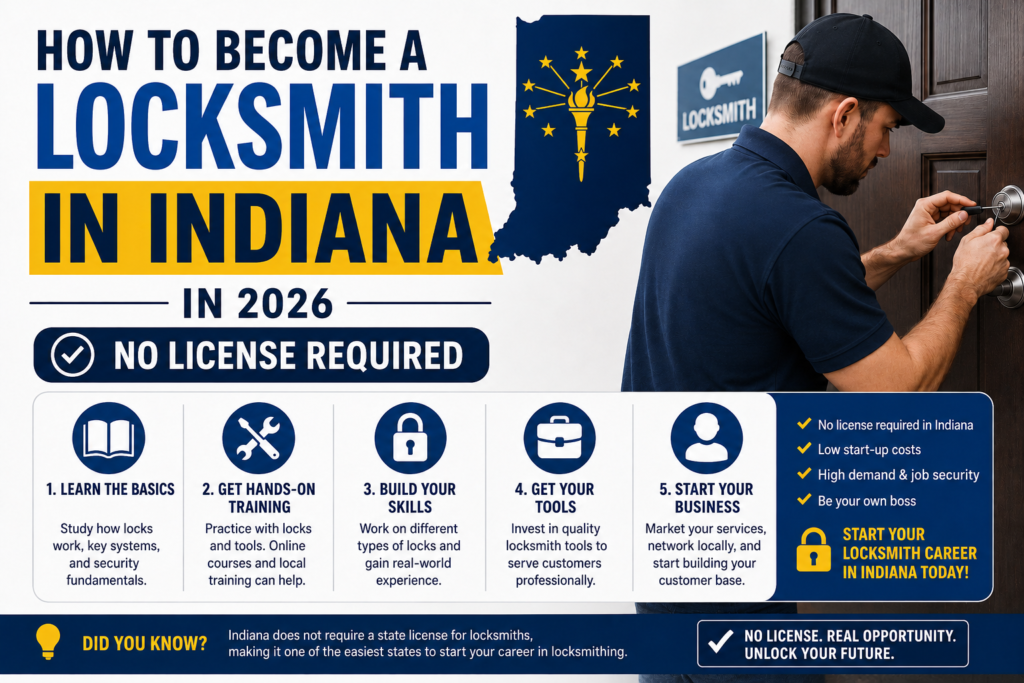
Indiana does not require a statewide locksmith license. You can start working as a locksmith after completing training or an apprenticeship, registering your business, and checking local city or county rules. No state exam, no background check, no mandatory certification.
Here is the short version of how to become a locksmith in Indiana in 2026:
- State license: none required
- Training: apprenticeship with a local locksmith, community college program, or ALOA or Foley-Belsaw online course (3 to 12 months)
- Local permits: Indianapolis and some other cities may require a business license, background check, or commercial permit
- Starter tools: $500 to $2,000 for picks, key machine, and code tools; transponder programmer adds another $500 to $2,000
- Insurance: general liability strongly recommended for any mobile or commercial work
- Indiana pay: $16 to $20 an hour entry level, $25 to $35 an hour experienced, $50,000 to $85,000 and up self-employed
If you are still deciding on the career, start with what a locksmith does day to day, and how much locksmiths make across the country. This guide covers everything from training to getting your first paying jobs in Indianapolis, Fort Wayne, Evansville, or anywhere else in the Hoosier State.
Does Indiana Require a Locksmith License?
No. Indiana has no statewide locksmith license.
Unlike states such as California, Connecticut, or Florida, Indiana has no mandatory state-issued credential just to work as a locksmith. That makes entry into the field more straightforward here than in most states. Indiana sits in the same no-license category as Arkansas, Colorado, Idaho, and Alaska.
That said, no license required does not mean no skills required. You still need proper training, and some local municipalities may have their own rules. Always check with your county or city before you start working.
Step 1: Understand What the Job Actually Involves
Before you invest in training, know what you are signing up for. Locksmiths do a lot more than unlock car doors.
A typical locksmith in Indiana might handle:
- Residential lockouts and rekeying
- Commercial lock installation and master key systems
- Automotive key programming and ignition work
- Safe opening and combination changes
- Security assessments and hardware upgrades
If you want a fuller picture of the day-to-day, read our breakdown of what a locksmith actually does. It covers the work in detail and helps set realistic expectations.
Step 2: Get Trained. Your Options in Indiana
You have three main paths to learn the trade.
Option A: Apprenticeship
This is the most practical route. You work under an experienced locksmith, earn while you learn, and build real-world skills fast. Look for established locksmith shops in Indianapolis, Fort Wayne, or Evansville and ask about apprentice openings directly.
Option B: Vocational or Trade School
Some community colleges in Indiana offer security or locksmithing-related coursework. It is more structured than an apprenticeship, and it gives you a credential you can show clients early on.
Option C: Online Plus Hands-On Training
Organizations like ALOA (Associated Locksmiths of America) and Foley-Belsaw offer distance learning programs. You study the theory online, then practice on actual lock hardware sent to you. It works, but you will want hands-on time before going solo.
No matter which path you pick, make sure your training covers lock picking, key cutting, transponder programming, and basic safe work. Those four areas cover 90 percent of what you will see in the field. Knowing how to identify a key is another fundamental skill to add early.
Step 3: Get Certified (Optional but Smart)
Indiana does not require it, but getting certified through ALOA or a similar body makes a real difference. It signals to customers and employers that you have been tested. The two most recognized entry-level credentials are:
- ALOA Registered Locksmith (RL): good starting credential
- Certified Registered Locksmith (CRL): next step up, more recognized by commercial clients
Certification also tends to increase what you can charge. We have covered how much locksmiths make. Certified techs consistently earn more than uncertified ones doing the same work.
Step 4: Check Local Licensing Requirements
Indiana has no statewide law, but some cities have local ordinances. Indianapolis, for example, may require a business license and background check before you can operate commercially. Do not skip this step.
Call your county clerk’s office or check with your city’s business licensing department. It takes 20 minutes and saves you from fines later.
Step 5: Get Your Tools and Set Up Your Business
Once you are trained, you need the right equipment. A basic starter kit includes:
- Pick sets (tension wrenches, hooks, rakes)
- Key cutting machine
- Code machine or key duplicator
- Transponder programmer for automotive work
- LISHI tools for high-security locks
- Plug follower and pinning trays for rekeying
If you are going mobile (which most new Indiana locksmiths do), you will also need a reliable vehicle and a way to organize your inventory. A cargo van with shelving works well.
For automotive work specifically, understanding how to program a transponder key is essential. It is one of the highest-demand services right now, and customers will pay well for it. Pair that with key fob copying and ignition cylinder replacement skills to unlock the highest-paying automotive jobs.
Step 6: Build Your Reputation Locally
In Indiana’s smaller cities and towns, reputation is everything. Your first 10 to 20 jobs will come from people you know or neighbors who heard about you. Treat those jobs like auditions.
A few things that help early on:
- Get a Google Business Profile set up immediately
- Ask every satisfied customer for a review
- Join your local chamber of commerce
- Partner with property management companies. They need locksmiths constantly
If you are considering working for an established shop first rather than going independent, that is a smart move. You will learn how experienced locksmiths verify ownership before opening a door and handle situations that training alone will not fully prepare you for.
What Does a Locksmith in Indiana Earn?

Pay varies by location and specialization. In Indiana:
- Entry-level: $16 to $20 an hour working for a shop
- Experienced: $25 to $35 an hour
- Self-employed: $50,000 to $85,000 and up per year depending on volume and services
Automotive and commercial work pay the most. Residential lockouts are the most frequent calls. The ideal business mixes all three.
Indiana’s cost of living is relatively low compared to coastal states, so even mid-range locksmith income goes further here. That is part of what makes this state attractive for starting out.
Can a Felon Become a Locksmith in Indiana?
This comes up more than you would think. Indiana has no blanket statewide ban, but individual employers and licensing bodies may consider your record. We have written a detailed post on whether a felon can become a locksmith that is worth reading if this applies to you.
The short version: it depends on the nature of the offense and who you are working with. Going the self-employed route tends to offer more flexibility.
Other State Locksmith Licensing Guides
Indiana’s no-license approach keeps the barrier low. Compare it to other states:
States that require a locksmith license or registration:
States with no statewide locksmith license:
For a full overview of state-by-state rules, see our national guide on whether you need a license to be a locksmith.
The Bottom Line
Becoming a locksmith in Indiana in 2026 is one of the more accessible skilled trades you can enter. Low barrier to entry, solid earning potential, and steady demand. Get trained, get certified if you can, check your local rules, and start building a reputation. That is the whole roadmap.
