
Hawaii does not require a statewide locksmith license. You can start working as a locksmith after getting training, buying basic tools, and registering your business with the Hawaii Department of Taxation for a General Excise Tax license. No state exam, no background check, no apprenticeship hours required.
Here is the short version of how to become a locksmith in Hawaii in 2026:
- State license: none required
- Age requirement: 18 years or older
- Training: ALOA online courses, Penn Foster, or out-of-state apprenticeship ($200 to $1,500)
- Required business registration: General Excise Tax (GET) license ($20) plus county business license ($10 to $20)
- Starter tools: $500 to $2,000 for a basic kit
- Average Hawaii salary: $57,607 to $59,770 a year ($27.70 to $28.74 an hour), above the national average
If you are still deciding on the career, start with what a locksmith does day to day, and how much locksmiths make across the country. Hawaii is one of the simplest states to break into, but “simple” does not mean you can skip the important steps.
Does Hawaii Require a Locksmith License?
No. Hawaii does not require state-level locksmith licensing.
This is completely different from states like California, Connecticut, or North Carolina, where you need state licensing and background checks. Hawaii sits in the same no-license category as Alaska, Arkansas, and Colorado. In Hawaii, you are free to start working as soon as you have the skills.
But here is the catch: no license requirement means anyone can call themselves a locksmith. Homeowners have been burned by scammers, so you will need to prove you are legitimate.
What You Actually Need to Work as a Locksmith in Hawaii
While Hawaii does not mandate locksmith certification, you still need three things:
Age Requirement: you must be 18 years old.
Good Moral Character: while there is no official background check requirement, most employers and customers expect it. Criminal history will not automatically disqualify you, but transparency matters.
Business License (If Self-Employed): if you are starting your own locksmith business, you will need a General Excise Tax (GET) license from the Hawaii Department of Taxation. More on this later.
That is it for the legal requirements. But if you want to actually make money and build trust, you will need training and certifications.
How to Become a Locksmith in Hawaii: 5 Steps
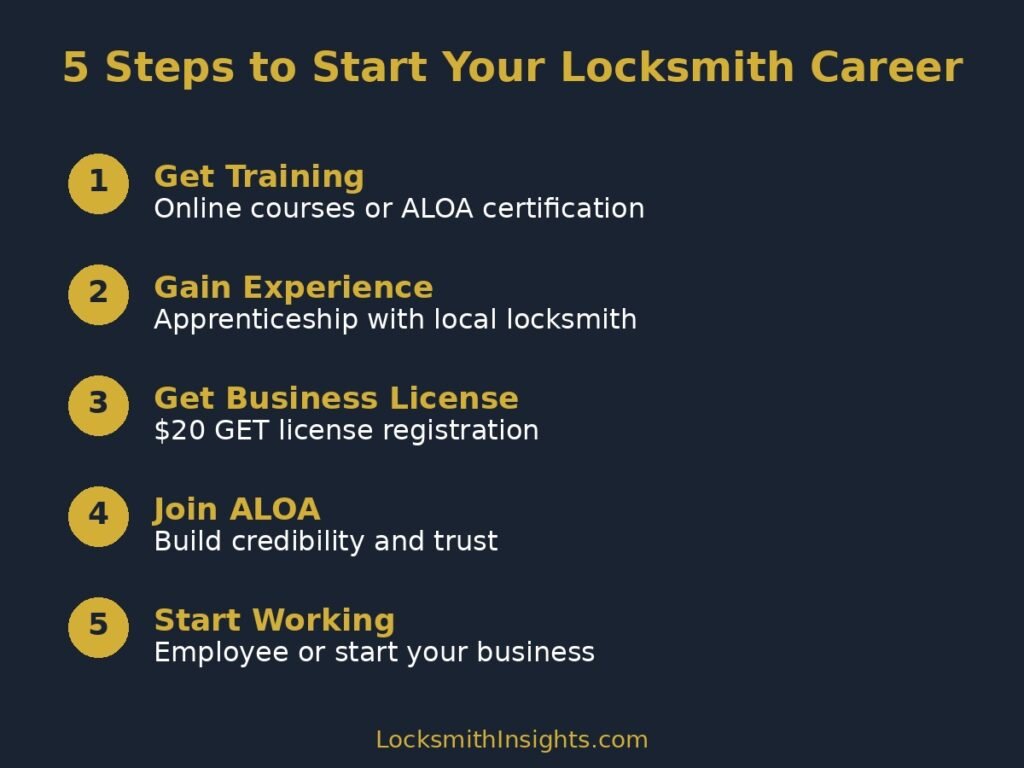
Here is the realistic path to follow.
Step 1: Get Training (Even Though It Is Not Required)
Hawaii does not have local locksmith trade schools, so you will need to look at online options or out-of-state programs.
Your best bet is the Associated Locksmiths of America (ALOA). Their membership includes access to hundreds of online courses, seminars, and conventions. This is the industry standard for locksmith training across all states.
Other solid distance learning programs include:
- Penn Foster Locksmith Career Diploma: can be completed in as little as 2 months
- Stratford Career Institute: comprehensive general locksmithing course
- Foley Belsaw Locksmithing: self-paced home study program
These programs teach you how to identify and create keys, work with different lock types including safes and vaults, and handle automotive locks. You will also learn how locksmiths open doors without causing damage.
Step 2: Get Real-World Experience
Book knowledge only gets you so far. You need hands-on experience.
Plan on working for an established locksmith company for at least 6 to 12 months before going solo. You will learn the business side. Things like how locksmiths verify ownership, handle emergency lockouts, and deal with difficult situations.
Most locksmith companies in Honolulu, Hilo, and Kailua-Kona will hire apprentices without prior experience if you have completed basic training. You will start with simple tasks like key duplication and residential lockouts, then gradually move into more complex work like programming transponder keys and automotive locksmithing.
Step 3: Join ALOA and Get Certified
This is where you separate yourself from the scammers.
ALOA offers several certification levels:
- Registered Locksmith (RL): entry level
- Certified Registered Locksmith (CRL): requires passing mandatory exam plus 2 electives
- Certified Professional Locksmith (CPL): advanced level with 12 additional electives
- Certified Master Locksmith (CML): top tier requiring 9 more electives
For automotive work, you can pursue:
- Certified Automotive Locksmith (CAL): entry level auto specialist
- Certified Master Automotive Locksmith (CMAL): advanced auto certification
There are also specialized certifications for safe and vault work (CPS, CMST) and electronic security systems.
Step 4: Register Your Business (If Going Solo)
If you are starting your own locksmith business in Hawaii, you will need to handle the business side.
General Excise Tax (GET) License: this is mandatory. File Form BB-1 with the Hawaii Department of Taxation. The filing fee is $20. You can file online through Hawaii Business Express.
Business Entity Registration: choose your structure:
- Sole proprietorship with trade name (DBA)
- LLC (filing fee around $50)
- Corporation (filing fee around $50)
County / City Business License: requirements vary by county:
- Honolulu County: business license through Department of Customer Services
- Hawaii County: business license through Vehicle Registration and Licensing Division (about $10 a year)
- Maui County: check with the county licensing office
- Kauai County: license through Motor Vehicle and Licensing Division
Federal EIN: get your Employer Identification Number from the IRS (free). You will need this for business banking and taxes.
Step 5: Get Insurance
Even though insurance is not legally required, you absolutely need it.
General Liability Insurance costs $500 to $1,500 a year and protects you if something goes wrong during a job. Imagine accidentally damaging a customer’s door frame during a lockout. Without insurance, you are paying out of pocket.
Commercial Auto Insurance is essential if you are running a mobile locksmith service. Most Hawaii locksmiths operate mobile services with vans stocked with tools and equipment.
How Much Do Locksmiths Make in Hawaii?
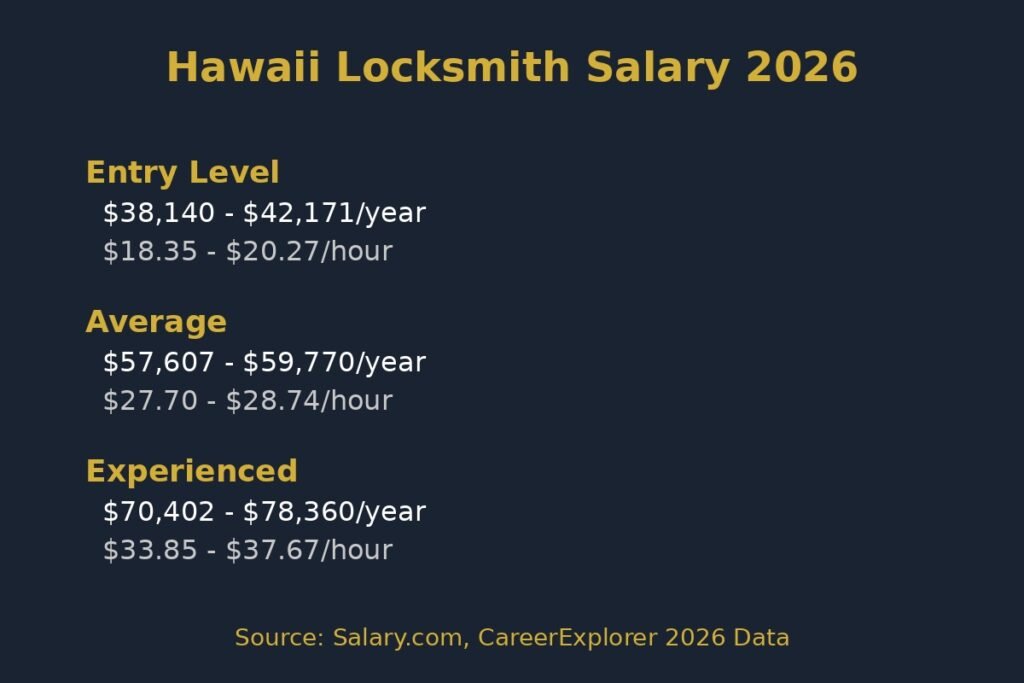
The money in Hawaii is solid, especially compared to the national average.
According to the latest salary data from Salary.com and CareerExplorer:
Average Annual Salary: $57,607 to $59,770. Hourly Rate: $27.70 to $28.74.
Here is the breakdown by experience level:
Entry Level (0 to 2 years)
- Annual: $38,140 to $42,171
- Hourly: $18.35 to $20.27
Mid-Career (3 to 5 years)
- Annual: $57,607 to $59,770
- Hourly: $27.70 to $28.74
Experienced (6 or more years)
- Annual: $70,402 to $78,360
- Hourly: $33.85 to $37.67
This is notably higher than many other states. For comparison, locksmith salaries in Ohio average around $50,000, while Texas locksmiths earn similar amounts to Hawaii.
The higher cost of living in Hawaii drives these wages up. But it also means your business operating costs will be higher too.
Factors That Affect Your Hawaii Locksmith Income
Specialization Matters. Automotive locksmiths who can reprogram key fobs and replace ignition cylinders typically earn more than residential-only locksmiths. Commercial work also pays better than residential.
Location. Honolulu and other urban areas have more demand and higher service rates. Rural areas have less competition but fewer customers.
Business Model. Self-employed locksmiths can earn significantly more than employees, but you are also covering all your own expenses, insurance, and tools.
Emergency Services. Offering 24/7 emergency lockout services can boost your income substantially. Late-night and weekend calls typically command premium rates.
Cost to Start a Locksmith Business in Hawaii
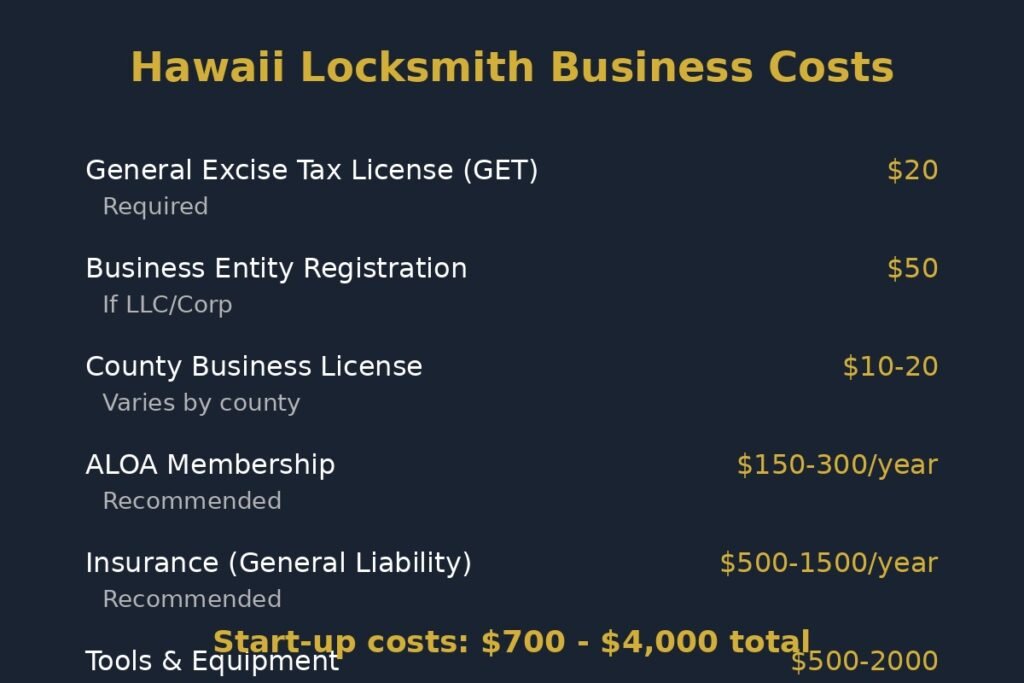
Let us talk real numbers. Here is what you will actually spend to get started.
Required Expenses:
- General Excise Tax (GET) License: $20
- Business Entity Registration (LLC or Corp): $50
- Basic Tool Kit: $500 to $1,000
- Total Minimum: $570 to $1,070
Recommended Expenses:
- ALOA Membership: $150 to $300 a year
- Training Courses: $200 to $500
- General Liability Insurance: $500 to $1,500 a year
- Commercial Vehicle Insurance: $1,200 to $2,000 a year
- Professional Key Cutting Machine: $500 to $2,000
- Mobile Service Van Setup: $2,000 to $5,000
- Total Realistic Budget: $5,000 to $12,000
County business licenses vary ($10 to $20 depending on your location). Some counties like Hawaii County require minimal fees through their Vehicle Registration and Licensing Division.
The Hawaii Locksmith Market: What You Need to Know
Working as a locksmith in Hawaii comes with unique challenges and opportunities.
Island Geography Matters
Hawaii’s island geography creates natural service territories. If you are based in Honolulu on Oahu, you are not competing with locksmiths in Hilo on the Big Island. This limits competition but also restricts your market size.
Each island has different dynamics:
- Oahu: largest population, most competition, highest demand
- Maui: strong tourism industry, seasonal demand spikes
- Big Island: large geographic area, rural communities
- Kauai: smaller market, less competition
Tourism Creates Opportunities
Hawaii’s massive tourism industry means constant demand for locksmith services. Rental property managers, hotels, and vacation rentals need lock rekeying, safe services, and emergency lockout help for tourists who have lost their keys.
Weather and Climate
The tropical climate is easier on your tools than harsh winter states. You will not deal with frozen locks like locksmiths in Pennsylvania face. But high humidity and salt air (especially near the coast) can corrode equipment faster if you do not maintain it properly.
Proper lock maintenance and lubrication is critical in Hawaii’s climate.
Building Trust Without State Licensing
Since Hawaii does not require locksmith licensing, you need to work harder to prove you are legitimate.
Get Certified Through ALOA. Even though it is not required, professional certification shows customers you are serious. Display your certifications prominently on your website, van, and business cards.
Undergo Voluntary Background Checks. Contact your local police department to get fingerprinted and run a background check. Show this documentation to potential customers.
Join Professional Organizations. ALOA membership is not just for training. It also signals professionalism. List it everywhere.
Build Online Presence. Get Google Business Profile reviews. In today’s market, online reviews are more important than any license. Ask satisfied customers to leave reviews.
Proper Business Registration. Having a legitimate business license, insurance, and proper vehicle identification shows you are not a fly-by-night operation.
Common Hawaii Locksmith Services and Pricing
Understanding typical service pricing helps you price competitively while staying profitable.
Residential Services:
- Home lockout: $70 to $150
- Lock rekeying per lock: $20 to $35
- New lock installation: $100 to $250
- Master key systems: $150 to $500
Automotive Services:
- Car lockout: $75 to $200
- Transponder key programming: $150 to $300
- Ignition cylinder replacement: $200 to $400
- Key fob replacement: $100 to $250
Commercial Services:
- Office lockout: $100 to $250
- High-security lock installation: $200 to $500
- Access control systems: $500 to $2,000 and up
- Safe and vault services: $150 to $500 and up
These are Honolulu-area prices. Rural areas typically charge 10 to 20 percent less, but you will also have fewer calls.
Should You Work for a Company or Start Your Own Business?
Both paths work in Hawaii, but they are very different.
Working for a Locksmith Company
Pros: no startup costs, steady paycheck, someone else handles marketing, learn the business without risk.
Cons: lower earning potential, no schedule flexibility, you are building someone else’s business.
Starting Your Own Locksmith Business
Pros: higher earning potential, set your own schedule, keep all the profits, build equity in a business.
Cons: startup costs ($5,000 to $12,000), irregular income at first, you handle all marketing, more stress and responsibility.
Most people do best working for someone else for 6 to 12 months first. Learn the business, build skills, and understand the local market. Then go solo when you are ready.
Common Questions About Becoming a Locksmith in Hawaii
Can I work as a locksmith with a felony in Hawaii? Yes, Hawaii does not require background checks for locksmiths. However, being a locksmith with a felony requires extra effort to build trust. Be upfront with employers and consider voluntary background checks to show you are reformed.
How long does it take to become a locksmith in Hawaii? You can start working in as little as 2 months if you complete an online training program quickly. Most people take 3 to 6 months to get trained and find their first position.
Do I need insurance to work as a locksmith in Hawaii? Legally? No. Practically? Yes. Insurance matters for locksmiths because one accident could bankrupt you.
Should customers tip locksmiths in Hawaii? Tipping is not expected, but it happens. Whether customers tip locksmiths depends on the service quality and situation. Emergency calls and exceptional service often get tips.
Can I specialize in just automotive locksmithing? Absolutely. Making car keys, programming key fobs, and replacing ignition cylinders is a growing specialty. Many locksmiths focus exclusively on automotive work.
Other State Locksmith Licensing Guides
Hawaii’s no-license approach is unusual. Compare it to other states:
States that require a locksmith license or registration:
States with no statewide locksmith license:
The Bottom Line on Becoming a Hawaii Locksmith
How to become a locksmith in Hawaii is straightforward: get training, gain experience, register your business, and start working. You do not need a state license, but you do need skills, insurance, and credibility.
Hawaii’s locksmith market offers solid earning potential ($57,000 and up average) without the regulatory burden of states like California or Florida. The island geography limits competition, tourism creates steady demand, and the pleasant climate makes this a great place to run a mobile service business.
Start with ALOA training, work for an established company for 6 to 12 months, then launch your own business once you understand the market. With minimal startup costs ($5,000 to $12,000) and strong earning potential, locksmithing in Hawaii is an accessible skilled trade that does not require years of formal education.
The lack of licensing requirements means you can start fast. But it also means you need to work harder to prove you are legitimate. Get certified, get insured, and build your reputation one satisfied customer at a time.
