
Delaware does not require a statewide locksmith license. You can start working as a locksmith after completing training, buying basic tools, registering your business with the Delaware Division of Revenue, and getting general liability insurance. There is no state exam, no mandatory apprenticeship, and no fingerprinting requirement.
Here is the short version of how to become a locksmith in Delaware in 2026:
- State license: none required (only master key systems must be reported to the Secretary of Public Safety every six months)
- Training: online course ($500 to $1,500), ALOA 5-day Fundamentals ($1,300 plus travel), or paid apprenticeship
- Business license: $75 a year through the Delaware Division of Revenue
- Starter tools: $500 to $2,000 for a key machine, picks, and basic kit
- Insurance: $300 to $800 a year for general liability, plus optional bonding ($75 to $200)
- Average Delaware salary: $55,816 a year ($27 an hour), with business owners earning $80,000 and up
If you are still deciding on the career, start with what a locksmith does day to day, and how much locksmiths make across the country. This guide covers everything from training to starting your first job in Wilmington, Dover, Newark, or the beach towns.
Do You Need a License to Be a Locksmith in Delaware?
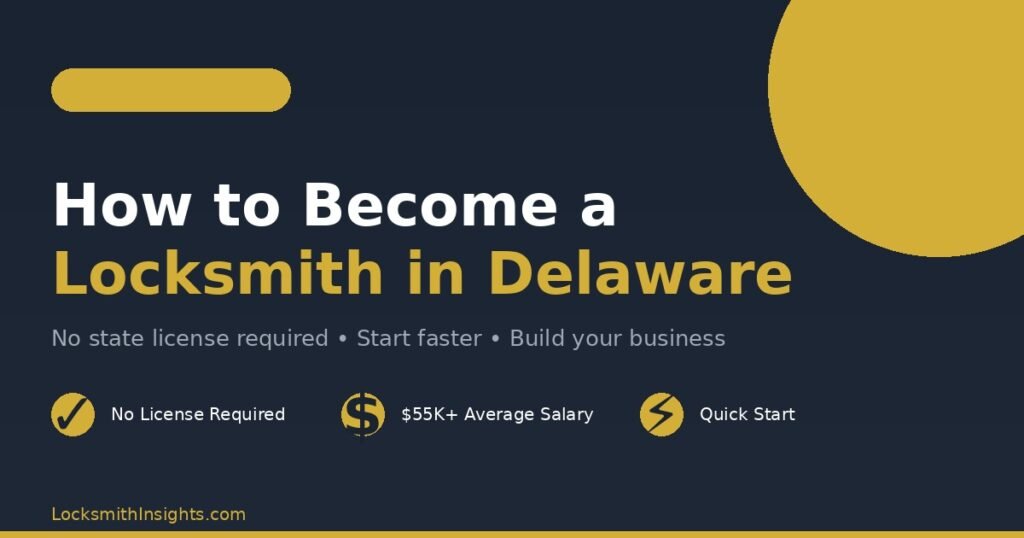
No. Delaware is one of the states that does not regulate locksmiths through licensing. Unlike Connecticut, Alabama, or North Carolina, you do not have to pass state exams or register with a regulatory board. Delaware sits in the same no-license category as Arkansas, Colorado, and Alaska. For a full 50-state comparison, see our licensing guide.
Does that mean anyone can just call themselves a locksmith? Technically, yes. But if you want to make real money and build a reputation, you will need actual skills and some credibility behind your name.
The only official requirement is if you have a master key system. Delaware law requires you to report master key information to the Secretary of Public Safety every six months. That is it.
What This Means for You
You can start working as a locksmith as soon as you have the skills and tools. No waiting for license approval. No worrying about exam dates. You could finish training on Friday and start taking jobs on Monday.
But here is the catch: just because you can start without credentials does not mean you should. Customers want to know you are legitimate. That is where ALOA certification comes in.
How to Become a Locksmith in Delaware: The Real Path
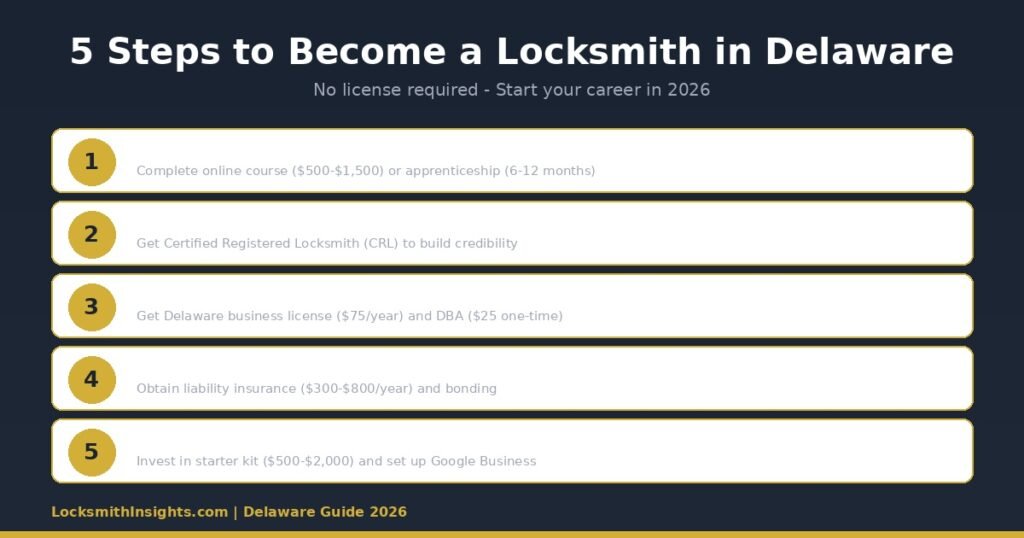
Since there is no state licensing process to follow, your path is pretty straightforward. Here is what you actually need to do.
Step 1: Get Training
You do not need a college degree. You do not even need a high school diploma, though it helps. What you do need is hands-on training with locks, keys, and security hardware.
There are a few ways to learn:
Online Locksmith Courses
Delaware does not have many local locksmith schools, so most people start with online training. Programs like Stratford Career Institute, Penn Foster, and Foley-Belsaw offer self-paced courses that cover:
- Residential lock installation
- Commercial security systems
- Automotive locksmithing
- Key duplication and rekeying, plus key identification
These programs usually cost $500 to $1,500 and take 3 to 6 months to complete at your own pace.
ALOA Training Programs
The Associated Locksmiths of America offers a 5-day Fundamentals of Locksmithing course in Dallas, Texas. It costs around $1,300 plus travel, but it is the most respected training in the industry.
You will work with actual locks, learn proper techniques, and get hands-on practice with tools like dial calipers, impressioning tools, and pick sets.
Apprenticeships
This is the old-school way. Find a working locksmith in Wilmington, Dover, or Newark and ask to work under them. You will learn on real jobs while getting paid (though probably not much at first).
Most apprenticeships last 6 months to 2 years. The experience you will get is worth more than any classroom training.
Step 2: Get ALOA Certification
Delaware does not require licensing, but customers do not know that. When they are choosing between you and another locksmith, they want credentials.
ALOA offers several certification levels:
Certified Registered Locksmith (CRL): Entry-level certification. Requires passing a mandatory exam plus two electives. This shows you know the basics.
Certified Professional Locksmith (CPL): Mid-level certification. Requires passing 12 additional electives after getting your CRL.
Certified Master Locksmith (CML): Top-tier certification. Requires passing 9 more electives after CPL. This is what separates you from weekend hobbyists.
Specialized Certifications:
- Certified Automotive Locksmith (CAL) for car key work
- Certified Professional SafeTech (CPS) for safe and vault work
- Institutional certifications for commercial facilities
Getting certified is not cheap. Exam fees run $50 to $150 each. But it is an investment that pays off. You can charge more, win more contracts, and separate yourself from uncertified competitors.
Step 3: Register Your Business
Even though you do not need a locksmith license, you do need to operate as a legitimate business. Here is what that means in Delaware.
Delaware Business License
Every business operating in Delaware needs a business license from the Division of Revenue. This costs $75 annually for a basic license.
You will register through the Delaware One Stop portal. The process takes about 15 to 20 minutes if you have all your information ready.
Business Structure
You need to decide how you will operate:
Sole Proprietorship: Simplest option. You and your business are legally the same. Easiest to set up but offers no liability protection.
LLC (Limited Liability Company): More protection. If something goes wrong on a job, your personal assets are protected. Costs around $90 to form in Delaware plus an annual franchise tax.
Corporation: Usually overkill for a solo locksmith, but some people prefer the structure.
Most locksmiths start as sole proprietors and switch to an LLC once they are established.
Trade Name / DBA Registration
If you want to operate under a business name (like “First State Lock and Key” instead of your personal name), you will need to register a DBA (Doing Business As).
Delaware has moved DBA registration to a statewide system through the Division of Revenue. It costs $25 and is done online through Delaware One Stop. You do not need to renew it. Once it is registered, it stays active as long as your business license is current.
Step 4: Get Insurance
This is not legally required, but it is a mistake to skip it. Two types matter:
General Liability Insurance: Covers property damage and bodily injury. If you accidentally break a window while opening a house door, this pays for it.
Costs $300 to $800 annually for $1 million in coverage.
Bonding: Some commercial clients require you to be bonded. This protects them if you mess up or commit fraud.
Costs $75 to $200 annually depending on the bond amount.
Step 5: Buy Your Tools
You cannot work without the right equipment. Starter kits run $500 to $2,000 and typically include:
- Key cutting machine
- Lock pick set
- Plug followers and pinning tweezers
- Tension wrenches and rakes
- Rekeying kits
- Drill and drill bits
- Automotive tools (for car lockouts)
As you grow, you will add specialized equipment like transponder key programmers (for key fob work) and code cutters.
How Much Do Locksmiths Make in Delaware?
Let us talk money. Because that is why you are reading this.
Average Delaware Locksmith Salary
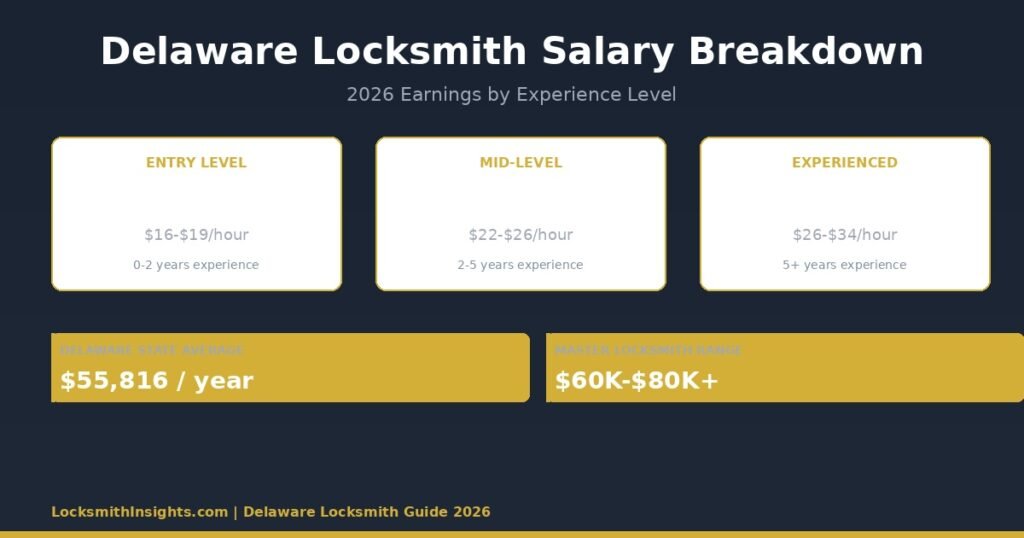
$55,816 a year or $27 an hour. That is the statewide average according to 2026 salary data.
Like any service business, your actual income depends on several factors.
Location Matters
Wilmington locksmiths average $56,607 annually ($28 an hour). Dover, mentioned as one of the highest-paying cities nationally for locksmiths, offers similar rates. Smaller towns like Georgetown or Milford might see slightly lower averages, but you will also face less competition.
Experience Matters More
Entry-Level (0 to 2 years): $34,000 to $40,000 annually. You are still learning, taking simple jobs like rekeying homes and basic lockouts.
Mid-Level (2 to 5 years): $45,000 to $55,000 annually. You can handle most residential and commercial jobs, including mortise locks and access control systems.
Experienced (5 or more years): $55,000 to $70,000 and up annually. You have built a client base, have specialized skills (like automotive or safe work), and can charge premium rates.
Master Locksmiths: $60,000 to $80,000 and up annually. These are the people doing high-security installations, forensic work, and commercial contracts.
Self-Employment vs. Working for a Company
Working for a Locksmith Company
Starting salary: $15 to $18 an hour ($31,000 to $37,000 annually). After 2 to 3 years: $20 to $25 an hour ($41,000 to $52,000 annually).
Pros: steady paycheck, benefits, company provides tools and vehicle, insurance coverage.
Cons: lower earning ceiling, you are building someone else’s business.
Running Your Own Locksmith Business
First year: $30,000 to $50,000 (slow start while building reputation). Years 2 to 5: $50,000 to $80,000. Established business: $80,000 to $150,000 and up.
Pros: unlimited income potential, keep all profits, build equity in your business.
Cons: irregular income at first, you pay for tools and marketing, you handle all the business stuff.
Most successful locksmiths start by working for someone else for 1 to 2 years to learn the business, then go out on their own.
Delaware Locksmith Market: Where the Work Is
Delaware might be small, but it has work.
Wilmington Metro
Population 70,000 and up, with the metro area hitting 700,000. Tons of residential lockouts, commercial buildings, and automotive work. Competition is higher, but so is demand.
Dover
Capital city with about 40,000 people. State government buildings need security work, plus Dover Air Force Base creates military housing opportunities.
Newark
Home to University of Delaware. Student housing complexes need constant rekeying between semesters. Landlords are a reliable source of repeat business.
Beach Towns (Rehoboth, Lewes, Bethany)
Seasonal but lucrative. Summer rentals need locks changed constantly. Vacation homeowners need lock maintenance and security upgrades.
Types of Jobs You Will Get
Residential (40 to 50 percent of work):
- Home lockouts (your bread and butter)
- Rekeying after move-ins
- Lock replacements
- Smart lock installations
Automotive (30 to 40 percent of work):
Commercial (20 to 30 percent of work):
- Office building security
- Master key systems
- Access control installation
- Safe opening
Common Delaware Locksmith Questions
Can I start working immediately without training?
Legally? Yes. Delaware does not require licensing. Practically? Bad idea. You will lose customers, make mistakes, and probably damage someone’s property. Get training first.
Do I need a background check?
Not required by the state. But if you want to work with commercial clients or join a locksmith company, they will probably run one anyway.
Can a felon become a locksmith in Delaware?
Yes. Delaware does not have automatic disqualifications. But you will need to be upfront with clients and employers. Some commercial contracts might exclude you, but residential work is usually fine.
How do locksmiths verify they are legitimate?
Check our guide on how locksmiths verify ownership before opening locks. It covers checking IDs, property records, and other proof.
What about safe work?
Opening safes requires specialized training. You will need to understand different types of safe locks and manipulation techniques. ALOA offers SafeTech certifications specifically for this.
Do customers tip locksmiths?
Sometimes. See our piece on tipping etiquette for locksmiths. It is not expected but appreciated for exceptional service.
Does insurance cover locksmith services?
Depends on the situation. Check out our guide on insurance coverage for locksmith services to understand what is typically covered.
Marketing Your Delaware Locksmith Business
You can be the best locksmith in Delaware, but if nobody knows you exist, you are broke.
Google Business Profile
Set this up first. When someone searches “locksmith near me” in Wilmington at 2 AM, you want your name showing up. Use real photos of you working. Get customers to leave reviews. Update your hours and services.
Local SEO
Your website should mention Delaware cities by name. “Locksmith in Wilmington, Dover, Newark” helps you show up in local searches.
Vehicle Wrap
Turn your van or truck into a moving billboard. Include your phone number in huge letters. People remember seeing your vehicle around town.
Emergency Availability
Lockouts happen at midnight on Saturday. If you are willing to take those calls, mention it everywhere. “24/7 Emergency Service” is a huge selling point.
Word of Mouth
Real estate agents, property managers, and car dealerships all need locksmiths. Build relationships with these people. One property management company can keep you busy all year.
Tools Every Delaware Locksmith Needs
You cannot fake your way through this job. You need the right equipment.
Essential Starting Tools ($500 to $1,000)
- Manual key cutting machine
- Lock pick set with tension wrenches
- Plug spinners and followers
- Pinning kit
- Screwdriver set
- Drill with bits
- Flashlight (you will work in dark spaces)
Intermediate Tools ($1,000 to $3,000)
- Code cutting machine
- Automotive lockout tools (wedges, slim jims, air wedges)
- Key extractor set
- Scope (for looking inside locks)
- Lock lubricant (graphite, not WD-40)
Advanced Tools ($3,000 to $10,000 and up)
- Transponder key programmer
- Key identification tools
- Safe manipulation tools
- Electronic lock programming equipment
- Code cutting software
Do not buy everything at once. Start with basics, add tools as you get jobs that need them.
What About Neighboring States?
If you are considering working across state lines, here is what you need to know:
Pennsylvania: No state license required, similar to Delaware. Philadelphia metro area offers lots of work.
Maryland: Requires a locksmith license through the State Police. More paperwork but also bigger market in Baltimore.
New Jersey: Requires licensing. Tighter regulations but higher rates in the NYC metro area.
Most Delaware locksmiths stick to Delaware unless they are willing to deal with other states’ licensing requirements.
Other State Locksmith Licensing Guides
Locksmith licensing rules vary widely by state. Compare Delaware to other states:
States that require a locksmith license or registration:
States with no statewide locksmith license:
Your Next Steps
Here is what to do this week:
- Research training options (ALOA courses, online programs, or local apprenticeships)
- Register your business with the Delaware Division of Revenue through the Delaware One Stop portal
- Order a starter tool kit ($500 to $1,000 for basics)
- Set up a Google Business Profile before you take your first job
- Reach out to established locksmiths in Wilmington, Dover, or Newark about apprenticeships or partnerships
- Get insured with general liability coverage before your first paying job
Delaware makes it easier to become a locksmith than most states. No license required means you can start faster. But “easier to start” does not mean “easy to succeed.”
Get proper training. Get certified. Build your skills. Treat customers right. Do that, and you will build a solid business.
FAQ
How long does it take to become a locksmith in Delaware?
3 to 6 months for basic training, or 6 to 12 months with an apprenticeship. Since Delaware does not require licensing, you can start working as soon as you have the skills.
How much does locksmith training cost in Delaware?
Online courses: $500 to $1,500. ALOA 5-day course: around $1,300 plus travel. Apprenticeships may be free or low-cost while you earn.
Do I need to be 18 to become a locksmith in Delaware?
While not legally mandated, most training programs and insurance companies require you to be 18 or older.
Can I work as a mobile locksmith in Delaware?
Yes. Most Delaware locksmiths operate as mobile services. You will need a reliable vehicle, tools, and business insurance.
What is the best city in Delaware for locksmith work?
Wilmington offers the most volume. Dover has higher average rates. Beach towns are seasonal but lucrative in summer.
Do I need special tools for automotive work?
Yes. Car lockouts and key fob programming require specialized equipment beyond basic residential tools.
