
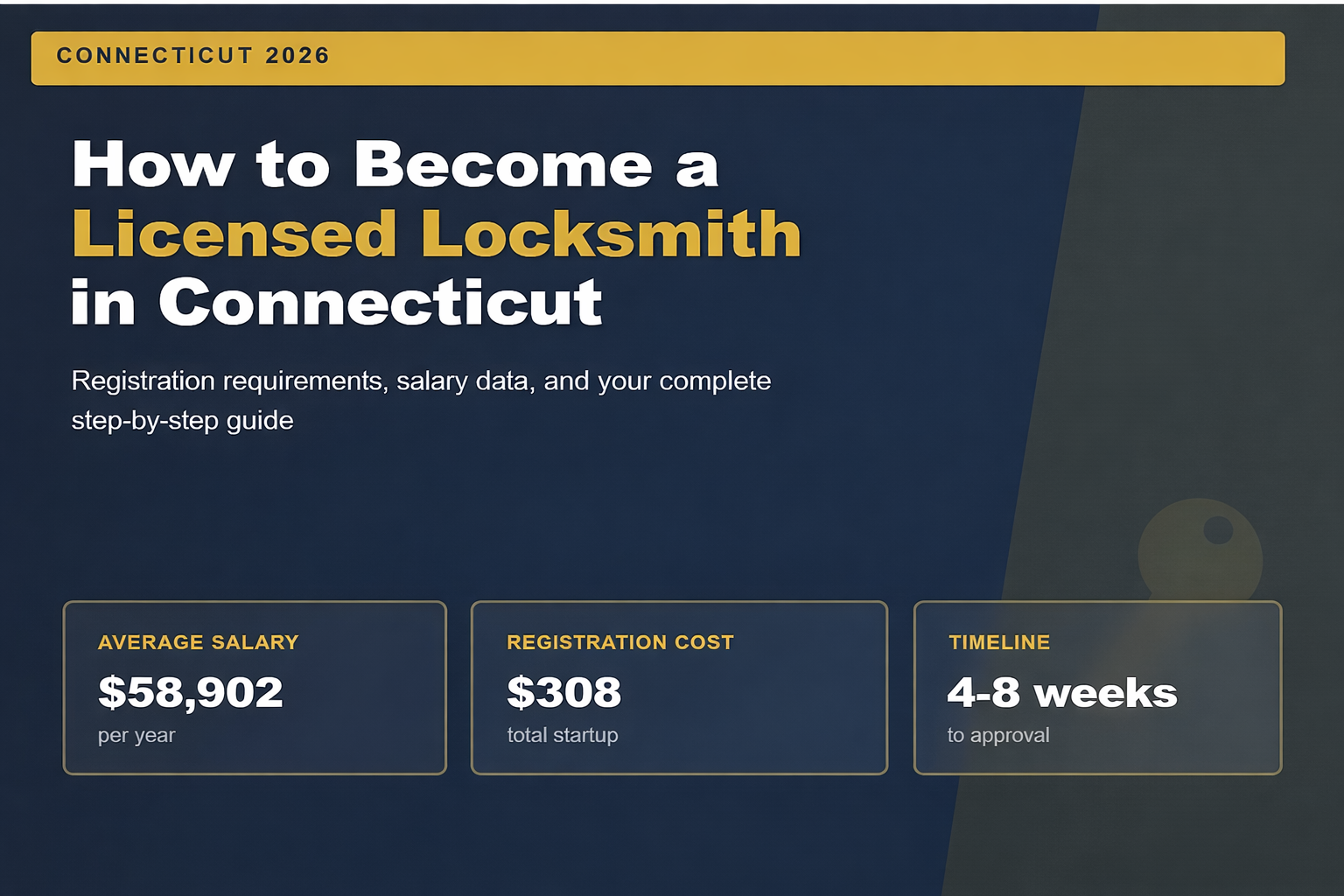
Connecticut does not issue a traditional locksmith license, but requires every working locksmith to register with the state Department of Consumer Protection (DCP). To register, you must be 18 or older, pass state and federal background checks, submit a notarized application, and pay a $200 registration fee. Processing takes 4 to 8 weeks.
Here is the short version of the Connecticut locksmith registration process in 2026:
- Regulator: Connecticut Department of Consumer Protection (DCP)
- Registration fee: $200, valid for two years
- Background checks: $75 state (CT only) plus $33 FBI fingerprint-based check
- Total startup cost: $308
- Total timeline: 4 to 8 weeks from application to approval
- Average Connecticut salary: $58,902 a year ($24.78 an hour), one of the higher-paying states
If you are still deciding on the career, start with what a locksmith does day to day, and how much locksmiths make across the country. This guide walks through the full Connecticut registration process, what your registration actually covers, and how to start working in Hartford, New Haven, Stamford, or Bridgeport.
Does Connecticut Require a Locksmith License?
Connecticut does not require a traditional locksmith license. Instead, you need to register with the state.
What is the difference? Registration is simpler. There is no exam to pass, no mandatory training courses, and no apprenticeship requirement. You just need to prove you are trustworthy through background checks and pay a fee.
Connecticut is one of roughly 13 states that regulate locksmiths at the state level, alongside Alabama, California, North Carolina, and Texas. That is very different from neighboring states like Arkansas, Colorado, or Alaska, which have no statewide locksmith registration at all. For the full 50-state comparison, see our licensing guide.
Getting registered takes about 4 to 8 weeks. Here is exactly what you need to do.

Step 1: Meet the Basic Requirements
Before you apply, make sure you meet these criteria:
- Age 18 or older
- No disqualifying criminal history (no convictions for dishonesty or violent offenses)
- Clean background checks from both state and federal agencies
If you have a felony record, do not panic. Connecticut reviews applications case by case. Minor offenses or expunged records may not disqualify you. Check our guide on whether a felon can become a locksmith for more details.
Step 2: Download and Complete the Application
Go to the Connecticut Department of Consumer Protection website and print the application.
It is 5 pages total, but you are only filling out one page. The rest is instructions and forms for background checks.
Pro tip: Get your application notarized. You will need a notary public present when you sign. Most banks offer free notary services to customers.
Step 3: Get Your Background Checks
Connecticut requires two separate background checks:
Connecticut State Criminal History Record:
- Request through the State Police Bureau of Identification
- Select “CT Only Criminal Conviction History Record Search”
- Cost: $75
- Processing time: 3 to 7 business days
FBI Identification Record:
- Request online at FBI.gov
- You will need to get fingerprinted at a local Connecticut State Police department
- Fingerprinting fee: $15
- FBI background check fee: $18
- Total FBI costs: $33
- Processing time: 5 to 10 business days
Start both checks at the same time. They are the slowest part of the process.
Step 4: Submit Your Application and Fee
Once you have both background checks, compile everything:
- Completed application (notarized)
- Connecticut criminal history report
- FBI identification record
- $200 registration fee (check or money order payable to “Treasurer, State of Connecticut”)
Mail everything to:
State Police Bureau of Identification
1111 Country Club Road
Middletown, CT 06457
Total startup costs: $308 ($200 registration plus $75 state check plus $33 FBI check)
Step 5: Wait for Approval
The Department of Consumer Protection reviews applications within 4 to 6 weeks. If there are no issues, they will mail your registration certificate.
Your registration is good for two years. It expires on December 31st of every even-numbered year (2026, 2028, and so on).
What Can You Do With a Connecticut Locksmith Registration?
Once registered, you can legally:
- Use the title “locksmith” in advertising and business operations
- Open locked doors for residential and commercial clients
- Install, repair, and rekey locks
- Create car keys and program transponder keys
- Provide emergency lockout services
- Run a locksmith business in Connecticut
What is NOT covered: simple key duplication does not require registration. If you are only cutting keys at a hardware store, you do not need to register.
How Much Do Locksmiths Make in Connecticut?
Connecticut pays locksmiths well. Really well.
Average Connecticut locksmith salary (2026):
- Hourly: $24.78
- Annual: $58,902
That is significantly higher than the national average of $55,116 a year. Connecticut ranks as one of the top-paying states for locksmiths, alongside Massachusetts, Rhode Island, and California.
Salary Breakdown by Experience
Your earnings grow as you gain skills:
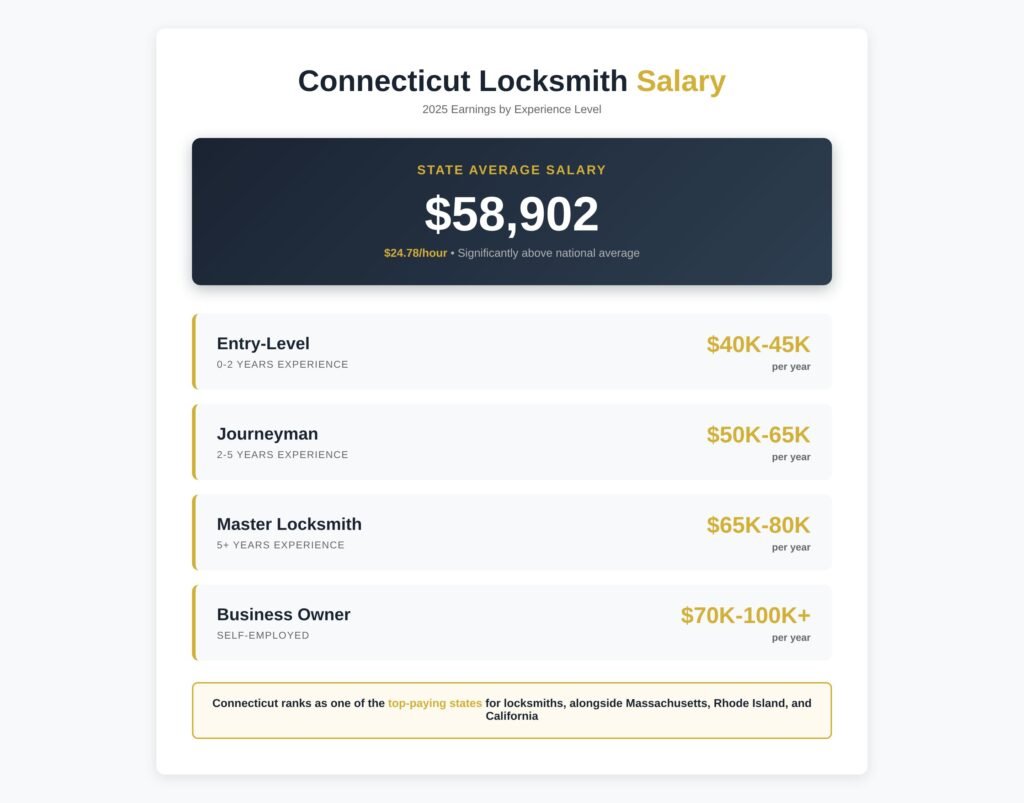
- Entry-level (0 to 2 years): $40,000 to $45,000 a year
- Journeyman (2 to 5 years): $50,000 to $65,000 a year
- Master locksmith (5 or more years): $65,000 to $80,000 a year
- Business owners: $70,000 to $100,000 and up a year
Top-Paying Connecticut Cities for Locksmiths
Some Connecticut cities pay above the state average:

- Orange: $57,800 a year
- Stamford: $56,200 a year
- Waterbury: $55,400 a year
- Hartford: $54,800 a year
- Bridgeport: $53,900 a year
Want to maximize your income? Learn how much locksmiths make in different specialties.
Do You Need Training to Become a Locksmith in Connecticut?
The honest answer: legally, no. Practically, yes.
Connecticut does not require any formal training or certification. You can technically register without ever touching a lock.
The problem is simple: you will not know how to do the job.
What does a locksmith do? Install deadbolts, rekey commercial buildings, program car key fobs, and handle emergency lockouts. None of that is intuitive. You should also be comfortable with key identification and basic lock mechanisms.
Best Training Options for Connecticut Locksmiths
1. On-the-Job Apprenticeship (Recommended)
Most successful locksmiths learn by working for an established locksmith company. You will get paid while learning, and you will see real-world scenarios that no classroom can replicate.
Look for apprenticeship opportunities with locksmith shops in Hartford, New Haven, Stamford, or Bridgeport. Expect to start at $15 to $18 an hour while training.
2. ALOA Certification (Optional but Valuable)
The Associated Locksmiths of America (ALOA) offers industry-recognized certifications. While not required in Connecticut, ALOA credentials boost your credibility.
Popular ALOA certifications:
- Certified Registered Locksmith (CRL): entry-level certification
- Certified Automotive Locksmith (CAL): for vehicle key specialists
- Certified Professional SafeTech (CPS): for safe and vault work
ALOA offers both online courses and hands-on training at their Dallas training center. Expect to invest $500 to $2,000 depending on the certification level.
3. Online Locksmith Courses
Several platforms offer self-paced locksmith training:
- Penn Foster Career School: comprehensive online program with physical lock kits mailed to your home
- ALOA Fundamentals of Locksmithing (AFL): online coursework plus one-day hands-on session
- Udemy locksmith courses: budget-friendly introductory classes ($20 to $100)
Online courses work best when combined with hands-on practice. Buy a lock kit and practice on your own doors.
Starting Your Locksmith Business in Connecticut
Ready to go solo? Connecticut makes it easier than most states.
Register Your Business
1. Choose a Business Structure
Most locksmiths start as sole proprietors. As you grow, you might form an LLC for liability protection.
2. Register with the Connecticut Secretary of State
- Sole proprietorship: no state registration required (just use your personal locksmith registration)
- LLC or corporation: file with the Connecticut Secretary of State
- Cost: $120 for LLC formation
3. Get an EIN from the IRS
If you are hiring employees or forming an LLC, you will need an Employer Identification Number. Get it free at IRS.gov.
4. Obtain Business Insurance
Connecticut does not require locksmith insurance, but you would be crazy not to get it. One mistake could wipe out your business.
Essential coverage:
- General liability insurance: $500 to $1,500 a year
- Professional liability (E&O): $300 to $800 a year
- Commercial auto insurance: $1,200 to $2,500 a year (if you are driving to clients)
Invest in Tools and Equipment
Starting a locksmith business requires upfront investment in tools:
Basic residential locksmith kit: $500 to $1,500
- Pin tumbler lock picks
- Key cutting machine (manual or electric)
- Plug spinners and tension wrenches
- Lock lubricants
- Screwdrivers, pliers, and measuring tools
Automotive locksmith tools: $2,000 to $5,000 (if you are doing car work)
- Key programmers for transponder keys
- Code cutting machines
- Vehicle-specific tools, including ignition cylinder replacement kits
Commercial locksmith tools: $1,000 to $3,000
- Master key system components
- High-security lock cylinders
- Door hardware installation tools
Buy quality tools. Cheap equipment fails when you need it most.
Connecticut Locksmith Laws You Need to Know
Connecticut locksmith law (Chapter 400p) includes important restrictions:
What You Cannot Do
- Use an expired or revoked registration: your registration must always be current
- Misrepresent your registration: do not claim your registration is an endorsement of quality
- Employ unlicensed salespeople: anyone selling on your behalf must be your direct employee
- Advertise fake locations: you cannot list branch offices you do not actually occupy
Who Is Exempt from Registration
These people can do locksmith work without registering:
- Municipal employees working on government property
- Students in approved locksmith programs
- Lock manufacturers providing warranty service on their own products
- Property maintenance staff at apartment buildings (for tenants only)
- Security personnel at schools
Verify Ownership Before Providing Services
Connecticut law does not explicitly require locksmiths to verify ownership, but verification is standard industry practice.
Always ask for:
- Residential lockouts: photo ID matching the property address
- Vehicle lockouts: vehicle registration and matching ID
- Commercial jobs: written authorization from the property owner or manager
Protect yourself legally. If a job feels sketchy, walk away.
Renewing Your Connecticut Locksmith Registration
Your registration expires on December 31st of every even-numbered year. Connecticut mails renewal notices 60 days before expiration, but it is your responsibility to renew on time.
Renewal process:
- Complete the renewal application (shorter than the original)
- Pay the $200 renewal fee
- Submit updated background checks if requested
Pro tip: set a calendar reminder for November 1st of your renewal year. Do not let your registration lapse. Working with an expired registration is illegal and can result in fines.
Common Questions About Becoming a Locksmith in Connecticut
Can I start working immediately after registering?
Yes, but we do not recommend it. Get training first. Damaging a customer’s lock because you do not know what you are doing will kill your reputation fast.
Do I need a business license in addition to locksmith registration?
It depends on your city. Some Connecticut municipalities require general business licenses. Check with your local town clerk’s office.
Can out-of-state locksmiths work in Connecticut?
Only if they register with Connecticut. There is no reciprocity. If you are licensed in New York or Massachusetts, you still need Connecticut registration to work here legally.
What happens if I fail the background check?
The Department of Consumer Protection reviews applications case by case. Minor offenses or old convictions may not disqualify you. Serious crimes involving dishonesty or violence typically result in denial.
Can I open safes without additional certification?
Legally, yes. Your Connecticut registration covers all locksmith services. However, safe work is specialized. Consider getting ALOA’s Certified Professional SafeTech (CPS) certification if you want to focus on types of safe locks, and review when a locksmith will open a safe.
Do I need insurance to register?
No. Connecticut does not require insurance for registration. But you absolutely should carry insurance before taking paying clients.
Is Becoming a Locksmith in Connecticut Worth It?
Yes, for most people. Here is why:
Pros:
- High demand: people always need locksmiths
- Above-average pay: Connecticut’s $58,902 average salary beats most trades
- Low barrier to entry: no exam, no mandatory training, minimal startup costs
- Flexible schedule: set your own hours or work for someone else
- Recession-resistant: lock and security needs do not disappear during economic downturns
Cons:
- Irregular hours: emergency calls come at 3 AM
- Physical work: you will be kneeling, drilling, and working in awkward positions
- Competition: Connecticut has established locksmith companies in every major city
- Startup costs: quality tools are not cheap
For most people, the pros outweigh the cons. Licensing requirements vary by state, but Connecticut’s registration process is straightforward compared to states like North Carolina or Texas.
Other State Locksmith Licensing Guides
Locksmith licensing rules vary widely by state. Compare Connecticut to other states:
States that require a locksmith license or registration:
States with no statewide locksmith license:
Your Next Steps to Becoming a Connecticut Locksmith
Here is your action plan:
- Order your background checks today (they take the longest)
- Download the registration application from the Connecticut DCP website
- Research training options (apprenticeships, ALOA courses, or online programs)
- Connect with local locksmiths (ask about apprenticeships or job opportunities)
- Submit your registration application once background checks arrive
- Invest in basic tools while waiting for approval
- Get insured before your first paying job
Questions about Connecticut’s locksmith registration? Drop us a message. We are here to help you start this career right.
